Odvex.Admin
Save time and money by checking the latest rankings and discounts on Odvex.
System Components and Technical Specifications
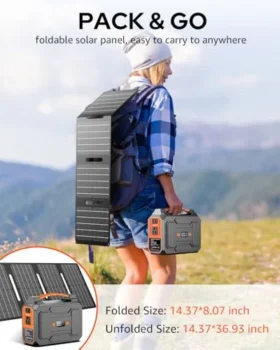
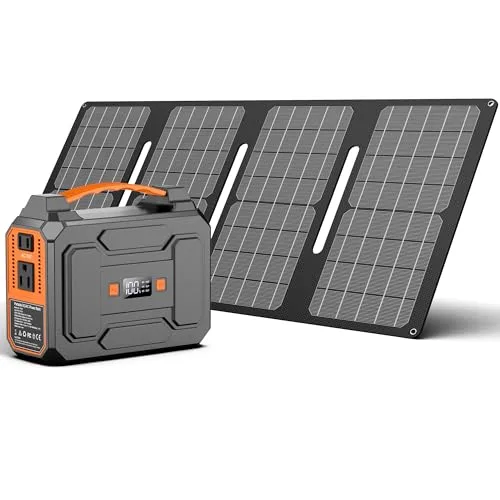
The Integrated 40W Solar Panel
The included solar panel is a critical differentiator. It is a folding design utilizing monocrystalline silicon cells, which generally offer higher efficiency (typically 21-24%) than older polycrystalline types, especially in sub-optimal light conditions. The 40W rating is the theoretical maximum output under Standard Test Conditions (STC: 1000W/m² irradiance, 25°C cell temperature). Real-world output is usually 60-80% of this, or 24-32W, depending on sun angle, cloud cover, and temperature.
The panel connects to the power station via an 8.5-foot cable terminating in a DC5521 connector, a common standard for small solar generators. The included array of 10 adapter tips significantly increases versatility, allowing the panel to charge not only the Apowking unit but also a wide range of other portable power banks, GPS units, or lights that use barrel plug connectors, adding substantial value to the kit.
The 146Wh Portable Power Station
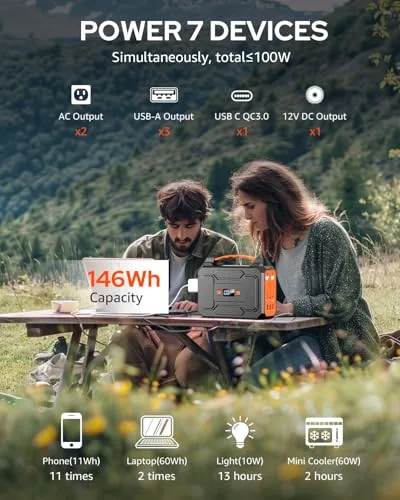
With a net capacity of 146 watt-hours (Wh), the power station’s internal battery stores a defined amount of energy. To contextualize, one watt-hour can deliver one watt of power for one hour. Therefore, a 10W device (like a LED light) could run for approximately 14.6 hours. A more practical metric is smartphone charges: a modern phone with a 15Wh battery can be fully recharged about 9-10 times from a full 146Wh battery, accounting for inverter and charging circuit efficiency losses of roughly 10-15%.
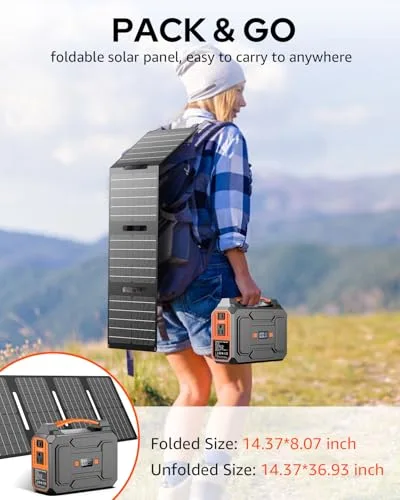
The station’s defining characteristic is its ultra-lightweight design at 3.3 pounds (1.5 kg). This is achieved through the use of a compact lithium-ion NMC (Nickel Manganese Cobalt) battery pack and a minimalist plastic housing. The output panel is comprehensive for its size, featuring:
- AC Output: Two 110V pure sine wave AC outlets rated for 100W continuous, 200W surge.
- DC Outputs: One 12V/10A DC5525 car-style port (max 120W).
- USB-A Outputs: Two standard 5V/2.4A ports and one Quick Charge 3.0 port (5V/3A, 9V/2A, 12V/1.5A).
- USB-C Output: One 5V/3A port (15W).
Integrated Safety and Utility Features
The unit incorporates a multi-mode LED light with a focused spotlight, a wide-area floodlight, a flashing strobe, and an SOS signal. This dual-functionality as a light source and emergency signal adds utility, particularly for camping or emergency scenarios.
Electronic protection is managed by a Battery Management System (BMS). This circuit monitors cell voltage, temperature, and current, providing protections against:
- Overcharge: Cuts off input when cells reach full voltage.
- Over-discharge: Shuts down output to prevent battery damage when capacity is critically low.
- Over-current & Short Circuit: Protects against faulty devices or wiring.
- Over-temperature: Reduces performance or shuts down if internal temperature is excessive.
Practical Performance and Real-World Applications
AC Output Limitations and Realistic Use
The 100W continuous AC output is the most critical specification to understand. It is sufficient for devices that consume under 100 watts, which includes almost all chargers for laptops, phones, cameras, and small electronics. For example, a typical 13-inch laptop charger draws 60-65W. It can also power small AC appliances like LED desk lamps, router/modem systems (15-30W), or a small fan.
It is categorically incapable of powering any appliance with a heating element or compressor. This includes coffee makers (800-1500W), microwaves (600-1200W), hair dryers (1200-1875W), refrigerators (starting surge 500-1500W, running 100-250W), and most kitchen equipment. Attempting to power such a device will trip the unit’s overload protection. The AC outlets are powered by a high-frequency inverter, which produces a clean sine wave suitable for sensitive electronics but is limited in peak power capability.
Recharging Dynamics and Battery Longevity
The system can be recharged via three methods:
- Wall Outlet (AC Adapter): The fastest method, typically refilling the 146Wh battery in 5-7 hours with the included 45W adapter.
- 12V Car Charger (Optional): Useful for topping up while traveling.
- Solar Panel (Included): The 40W panel, under ideal midday sun, can deliver ~30W. Recharging from 0% to 100% would theoretically take about 5 hours (146Wh / 30W ≈ 4.9h), but in practice, due to shifting sun angles and less-than-perfect conditions, a full solar charge often requires 6-9 hours of cumulative daylight.
Port Utilization and Charging Strategy
The seven output ports allow for simultaneous charging, but the total combined output cannot exceed the unit’s internal limits. A practical strategy is to use the USB-C and QC 3.0 ports for fast-charging smartphones and tablets, the standard USB-A ports for lower-power devices like headlamps or Bluetooth speakers, and the AC outlet for a laptop. The 12V DC port is suitable for a portable car cooler (under 120W) or a DC-powered fan. The intelligent circuitry will manage the load distribution, but users should be mindful that using all ports at maximum capacity simultaneously is not possible due to the total power budget of roughly 150W for all DC outputs combined.
Evaluating Advantages and Compromises
| Primary Advantages | Key Limitations and Trade-offs |
|---|---|
| Complete, Ready-to-Use System: Eliminates compatibility guesswork by including a matched solar panel and necessary cables in one box. | Modest Energy Capacity: 146Wh is suitable for personal electronics and short-term backup but insufficient for powering household appliances or multi-day, heavy device use for a group. |
| Exceptional Portability: At 3.3 lbs for the power station, it is one of the lightest units with an AC outlet, making it ideal for backpacking and hiking. | Constrained AC Power: The 100W AC limit excludes virtually all kitchen appliances and tools, restricting it to low-wattage electronics and chargers. |
| Versatile Connectivity: Offers a wide array of ports (AC, USB-C, QC 3.0, 12V DC) for charging nearly any personal device on the market. | Solar Charging is Supplemental: The 40W panel is best for extending runtime or slow, full-day recharging. It is not designed for rapid recharging of a depleted unit. |
| Integrated Utility & Safety: The multi-mode LED light adds practical value for outdoor and emergency use. The BMS provides essential electrical protections. | Battery Chemistry Longevity: The NMC battery has a shorter cycle life (~500 cycles) compared to premium LiFePO4-based competitors, impacting long-term value for frequent, deep-cycle users. |
Comparative Market Analysis
Positioning the Apowking 146Wh system requires comparison against other common portable power solutions. The table below highlights the fundamental trade-offs between a lightweight all-in-one kit, a higher-capacity modular station, and a simple high-capacity power bank.
| Feature / Metric | Apowking 146Wh Solar Generator Kit | Typical 256Wh LiFePO4 Power Station (e.g., Anker 521) | High-Capacity 100Wh USB Power Bank |
|---|---|---|---|
| Energy Capacity | 146 Wh | 256 Wh | ~100 Wh (27,000mAh at 3.7V) |
| Battery Chemistry | Lithium-ion (NMC) | Lithium Iron Phosphate (LiFePO4) | Lithium-ion (NMC) |
| Cycle Life (to 80%) | ~500 cycles | ~3000 cycles | ~500 cycles |
| AC Output | Yes, 100W Continuous (200W Surge) | Yes, 300W Continuous (600W Surge) | No |
| Solar Input Compatibility | Included 40W Panel & Built-in Charge Controller | Yes, but panel sold separately; requires specific voltage/current | Rarely; limited to small trickle-charge panels |
| Weight (Unit Only) | 3.3 lbs (1.5 kg) | 7.9 lbs (3.6 kg) | 1.2 lbs (0.55 kg) |
| Primary Use Case | Ultra-portable all-in-one solar kit for personal electronics during outdoor activities or brief outages. | Higher-demand backup power for CPAP machines, longer-duration work, or small appliances; long-term durability focus. | Exclusively charging USB-powered devices (phones, tablets, cameras) with maximum portability. |
| Cost Analysis | Lower upfront cost for a complete solar-capable system. | Higher upfront cost for the station alone, plus additional cost for a solar panel. | Lowest cost for USB-only charging. |
Ideal User Profiles
This product is designed for specific scenarios where its combination of features provides optimal value.
1. The Lightweight Backpacker or Cyclist: For multi-day trips where every ounce counts, the 3.3-pound power station paired with the folding 40W panel is a manageable way to keep a smartphone, GPS, camera, and headlamp powered. The ability to recharge via solar during the day extends independence indefinitely for low-power devices.
2. The Casual Camper or Festival-Goer: For car camping or events where weight is less critical but a convenient, quiet power source is desired. It can power string lights, charge multiple phones for a group, and run a small fan inside a tent, all without the noise or fumes of a generator.
3. The Urban Dweller Seeking Basic Emergency Preparedness: As a compact, affordable backup for short-duration power outages. It can keep a router/modem online for 8-10 hours, charge all family communication devices multiple times, and provide light. The solar panel offers a crucial recharging option if an outage persists beyond the initial battery capacity.
4. The Digital Nomad or Remote Worker in Mild Settings: Suitable for powering a laptop and peripherals for a full workday (with recharging via solar or wall outlet). It is best paired with a low-power laptop (e.g., MacBook Air, Chromebook) and is ideal for working from a park, cafe patio, or vehicle.
Who should consider an alternative: Users needing to power medical devices like CPAP machines (which often require 30-60W, plus humidity), those requiring backup for a refrigerator or sump pump, or anyone seeking a “set-and-forget” home backup solution for frequent or long outages should invest in a higher-capacity (500Wh+) power station, likely with LiFePO4 chemistry.
Final Assessment
The Apowking Solar Generator kit succeeds as a focused, entry-level solution for portable renewable power. Its greatest strength is simplification—providing a fully functional solar charging system in a single purchase. The integration of a matched 40W panel removes a significant barrier to entry for new users.
The compromises are clear and intentional: limited capacity and AC output in exchange for exceptional lightness and cost-effectiveness. It is not a whole-house backup device nor a tool for powering high-energy appliances. Instead, it is a highly capable personal power hub for the digital age, designed for mobility and small-scale energy independence.
For its target users—outdoor enthusiasts, casual campers, and those taking their first step into off-grid power—it delivers tangible utility and freedom. By setting realistic expectations around its 146Wh capacity and 100W AC limit, users will find it a reliable and convenient tool for keeping their essential modern devices operational, whether under the sun or during a temporary blackout.
Read more articles on this topic: Battery.