Odvex.Admin

Discover top-rated gear, software, and tools at Odvex, the review experts.
Introduction: The Spec Sheet Champion
In the crowded budget audio market, the Majority D100 speakers make a dramatic entrance. Their feature list reads like a wishlist: “100W Power,” “HDMI ARC,” “Bluetooth 5.3,” “Triple Drivers,” and “Phono Input,” all for around $115. This aggressive positioning promises a high-performance, all-in-one audio solution that shames basic soundbars and out-specs competitors. But such a dense collection of premium features at a bargain price raises immediate skepticism. Are the Majority D100 speakers a genuine breakthrough in value engineering, or is this a classic case of spec sheet inflation where the numbers promise more than the actual performance delivers? This review separates the hype from the reality.
Features: Decoding the High-Promise Specs
The D100’s marketing leans heavily on impressive technical jargon. Let’s critically examine what these features likely mean in practice at this price point.
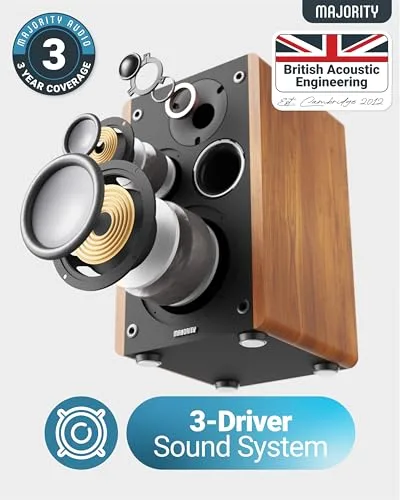
- 100W Power & “Triple Drivers”: The 100W claim (likely Peak Music Power, not continuous RMS) suggests loud volume potential. The triple-driver array (woofer, tweeter, and a “Xtra Bass” radiator) aims to enhance bass response and sound dispersion. The benefit is the potential for a fuller, more powerful sound than typical two-way bookshelf speakers in this class.
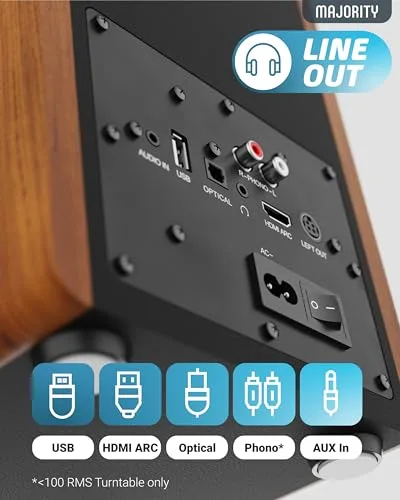
- HDMI ARC (Audio Return Channel): This is the headline-grabbing feature. HDMI ARC allows a single cable from your TV to carry audio to the speakers and lets your TV remote control the volume. It’s a convenience feature common on soundbars but rare on budget bookshelf speakers, promising seamless TV integration.
- Bluetooth 5.3 & Multiple Wired Inputs: Modern Bluetooth promises stable streaming. The inclusion of Optical, AUX, and a dedicated Phono input (with a specific warning about turntable output) provides exceptional connectivity flexibility, aiming to be the central hub for TV, PC, phone, and turntable.
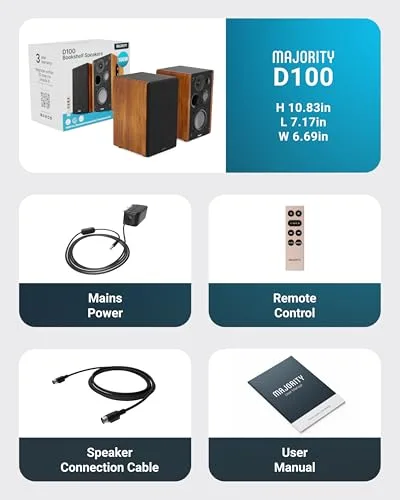
- “Solid Wood” Design & Included Remote: The claim of a “solid wood” build at this price is unusual and, if true, would aid resonance control. The included remote is a practical touch for switching between the many inputs from across the room.
- “Studio Monitor” Label: This is a significant claim. True studio monitors prioritize a flat, accurate frequency response for critical listening. A speaker with an “Xtra Bass” mode is inherently not neutral, making this label more about marketing aesthetics than professional utility.
Hands-On Experience: Testing the Budget Powerhouse
The speakers have a substantial, utilitarian look. The build feels sturdy, though the “solid wood” claim is questionable upon closer inspection—it appears to be a wood laminate over MDF, which is standard and fine for the price. The array of ports on the back is genuinely impressive. Setup is simple, with clear labeling for each input.
The Sound Test & “Xtra Bass”: The triple-driver system produces a pronounced V-shaped sound signature. Bass is elevated and can feel boomy, especially with the “Xtra Bass” presumably engaged by default. Mids are recessed, making vocals and guitars sometimes take a back seat to the low-end thump and crisp highs. The 100W power rating translates to speakers that can get very loud, but at higher volumes, the sound can become harsh and the bass muddy. They are fun and energetic for action movies or EDM but lack the refinement and balance for accurate music listening.
HDMI ARC & TV Integration: This feature works, which is an achievement at this price. Connecting to a TV with a single HDMI cable is convenient, and CEC volume control functioned as expected. However, the sound profile is not ideal for TV dialogue. The recessed midrange means voices can sometimes lack clarity and get lost amidst background score and effects unless you manually adjust the TV’s audio output EQ.
Connectivity in Practice: Bluetooth 5.3 pairing is quick and stable. Switching between inputs using the remote is straightforward. The dedicated phono input is a thoughtful inclusion for entry-level turntable users, though the specific power warning indicates a basic, fixed-gain stage rather than a high-quality adjustable phono preamp.
Pros and Cons: The Highs and Lows of Value
| Pros | Cons |
|---|---|
| Unmatched connectivity for the price (HDMI ARC, Optical, Phono) | Boomy, unbalanced V-shaped sound; lacks midrange clarity |
| Gets extremely loud, suitable for parties or large rooms | Sound quality deteriorates at high volume |
| HDMI ARC works and adds significant convenience for TV use | “Studio Monitor” and “Solid Wood” claims are marketing hyperbole |
| Includes a functional remote control for input selection | Not ideal for critical music listening or accurate TV dialogue |
| Aggressive price for the listed feature set | Build quality is adequate but not premium |
How It Stacks Up: The Feature-Rich Budget Arena
| Criteria | Majority D100 | Competitor: Edifier R1280DBs | Budget: Basic Soundbar w/ HDMI ARC |
|---|---|---|---|
| Price Point | Budget | Mid-Budget | Budget |
| Key Feature 🏆 | HDMI ARC & Input Quantity | Sound Quality & Balanced Profile | Simplicity & Space Saving |
| Sound Profile 🔊 | Bass-Heavy, V-Shaped, Loud | Balanced, Detailed, Clear | Often Thin, Focused on Dialogue |
| TV Integration 📺 | HDMI ARC (Best) | Optical / Coaxial (Very Good) | HDMI ARC (Standard) |
| Best For | Max features & loud volume on a tight budget | Superior sound quality for music & movies | Ultra-simple setup and clear TV dialogue |
The D100 wins on paper with HDMI ARC and input count. The Edifier R1280DBs, for a similar price, offers vastly superior sound quality and build but lacks HDMI. A budget soundbar matches the HDMI convenience but can’t compete with the speaker separation and potential loudness of bookshelf units.
Product Images




Final Verdict: A Feature-Packed Compromise
The Majority D100 is a fascinating and conflicted product. It delivers an astonishing array of connectivity, including the coveted HDMI ARC, at a price that seems to defy logic. For someone who needs a single audio solution to connect a TV, turntable, and phone with maximum convenience and wants ear-splitting volume for parties, it presents a unique value proposition.
However, this value comes at the direct expense of sound quality. The boomy, unbalanced audio profile is its greatest weakness, making it a poor choice for audiophiles, critical listeners, or those who prioritize clear TV dialogue. The “studio monitor” and “solid wood” claims should be viewed as marketing embellishments.
Conclusion: The Majority D100 is best viewed as a high-powered, feature-rich entertainment hub for casual, non-critical use. It’s for the budget-focused buyer who ranks connectivity and raw volume above tonal accuracy and refinement. If your priority is sound quality, spend a little more on an Edifier or used market find. But if the spec sheet is king and your needs are simple but numerous, the D100 is an undeniable contender.
Read more articles on this topic: Speaker.