Odvex.Admin
Discover top-rated gear, software, and tools at Odvex, the review experts.
Introduction: High-End Features on a Shoestring Budget
The market for budget bookshelf speakers is notoriously crowded, dominated largely by Edifier. However, for the consumer looking to upgrade from tinny laptop speakers or lackluster TV audio without spending over $100, the options often feel comprised. You usually have to choose between modern connectivity (like Bluetooth and Optical) or decent build quality. Rarely do you get both.
Enter the Prosonic BT30 Active Powered Speakers. Manufactured under the Singing Wood family—a brand with a surprising heritage in US-based audio support—these speakers aim to disrupt the entry-level tier. Boasting Bluetooth 5.3, digital optical inputs, and a claimed 80 Watts of power, the spec sheet reads like a product twice the price. But specifications are just numbers on a page. In this review, we analyze whether the Prosonic BT30 is a legitimate high-fidelity contender or just another budget box making loud promises.
Feature Analysis: Connectivity is King
Modern Digital Inputs
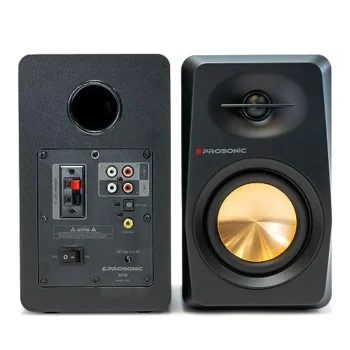
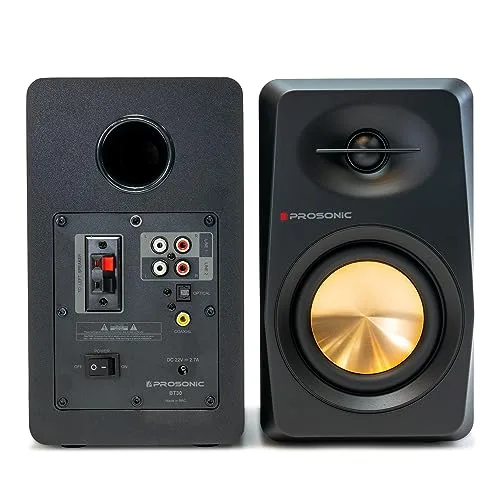
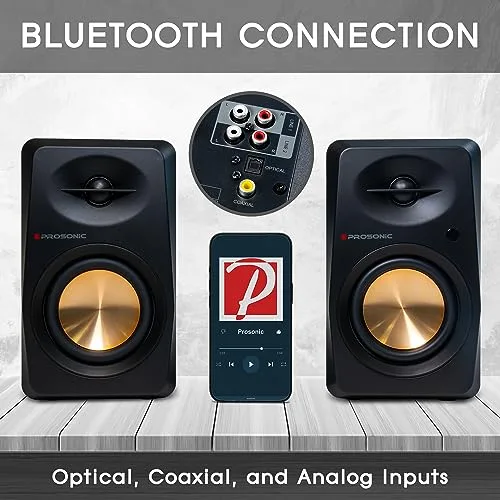
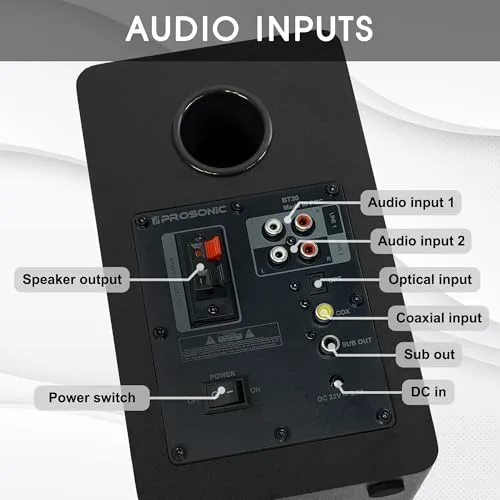
The standout feature of the BT30 is undoubtedly its connectivity suite. At this sub-$100 price point, most competitors offer only basic RCA analog inputs. Prosonic, however, includes both Optical and Coaxial digital inputs. This is a game-changer for home theater enthusiasts. It allows you to connect the speakers directly to a modern TV or gaming console, utilizing the speaker’s internal Digital-to-Analog Converter (DAC) for a cleaner, interference-free signal. This makes the BT30 a viable soundbar killer for small to medium-sized rooms.
Bluetooth 5.3 Technology
Wireless audio often suffers from latency and compression issues. By integrating the latest Bluetooth 5.3 chip, the BT30 ensures a robust connection with significantly lower latency than the older Bluetooth 4.0 or 5.0 standards found in rival speakers. This is particularly important if you plan to use these speakers for watching videos on a tablet or phone, as it keeps the dialogue perfectly synced with the actors’ lips.
Acoustic Construction and DSP
The cabinet construction utilizes High-Quality MDF (Medium Density Fiberboard) rather than cheap plastic. MDF is denser and acoustically inert, which helps to reduce resonance and vibration, ensuring that the sound you hear comes from the drivers, not the box rattling. Inside, the speakers are equipped with Digital Sound Processing (DSP) and Dynamic Range Control (DRC). These technologies work in the background to prevent distortion at high volumes, ensuring that the bass doesn’t “fart” out when you crank up the volume during a party.
Hands-On Experience: The Daily Driver Test
Setup and Desktop Use
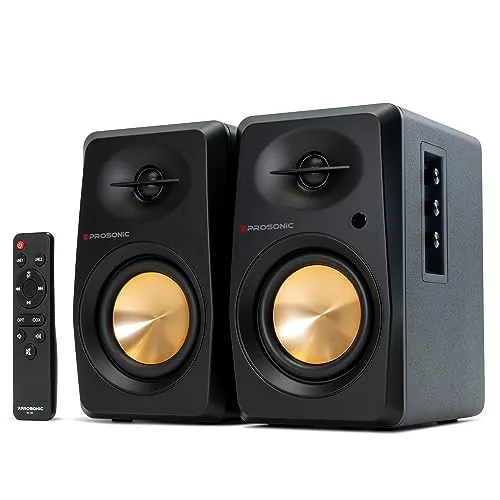
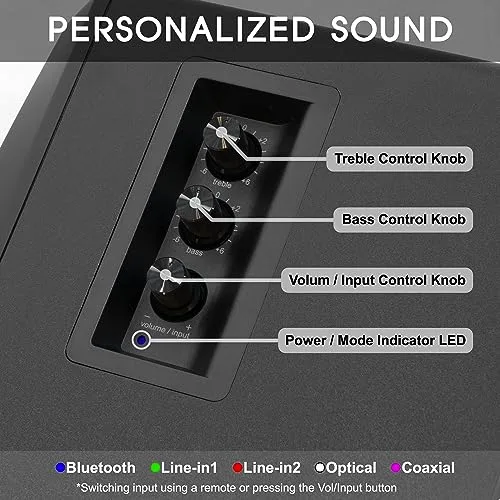
Setting up the Prosonic BT30 is a plug-and-play affair. The active speaker (right channel) houses the amplifier and connections, connecting to the passive speaker (left channel) via standard speaker wire. The inclusion of side-mounted controls for Volume, Bass, and Treble is a massive ergonomic plus. Unlike rear-mounted controls that require you to blindly fumble behind the speaker, these are easily accessible. The knobs provide tactile feedback, allowing you to dial in the EQ to suit your room’s acoustics instantly.
Sound Quality Performance
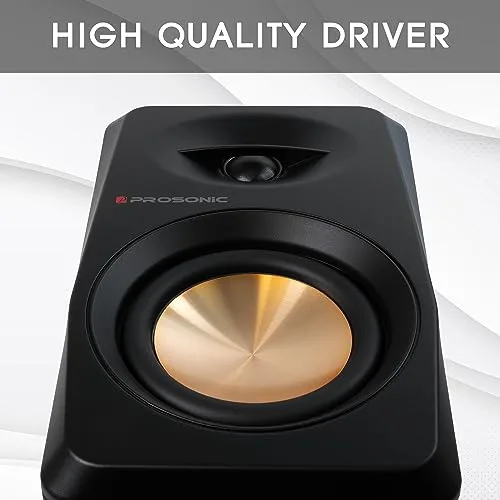
The Highs: The 0.75-inch silk dome tweeters deliver a smooth, airy treble response. Silk is generally preferred over Mylar or plastic tweeters found in cheap PC speakers because it sounds natural and less fatiguing over long listening sessions. Vocals in podcasts and acoustic tracks are rendered with surprising clarity.
The Lows: The 4-inch full-range bass drivers work hard to produce a full sound. With the side-mounted bass knob turned up, there is a decent punch for kick drums and bass guitars. However, physics has its limits. A 4-inch driver will not shake the floorboards with sub-bass frequencies (below 60Hz). For hip-hop or action movies, you will get the impact, but not the deep rumble of a dedicated subwoofer.
Versatility
We tested the dual RCA inputs by connecting a PC and a Turntable simultaneously. The ability to keep both wired without swapping cables is convenient. (Note: For turntables, ensure your player has a built-in preamp, as the BT30 does not have a phono stage). The remote control, while feeling somewhat lightweight and plasticky, functions well for switching inputs from the comfort of a couch.
Pros and Cons
| Pros | Cons |
|---|---|
| Excellent connectivity (Optical, Coax, RCA, BT 5.3). | Bass extension is limited by 4-inch driver size. |
| Bluetooth 5.3 offers low latency and stable range. | Remote control feels cheap compared to the speakers. |
| MDF wooden enclosure minimizes cabinet resonance. | No dedicated subwoofer output port for expansion. |
| Side-panel EQ controls are convenient and tactile. | Plastic faceplate detracts slightly from the premium look. |
| DSP processing keeps distortion low at max volume. |
Product Comparison
How does the Prosonic BT30 stack up against the market leader and an ultra-budget option?
| Feature | Prosonic BT30 (Main) | Edifier R1280DB | Creative Pebble Pro |
|---|---|---|---|
| Bluetooth 📶 | Version 5.3 (Newest) | Version 5.0 | Version 5.3 |
| Inputs 🔌 | Optical, Coax, RCA x2 | Optical, Coax, RCA x2 | USB-C, Aux |
| Power ⚡ | 80W (Peak) | 42W (RMS) | 30W (Peak) |
| Controls 🎛️ | Side Panel | Side Panel | Front Knob |
| Driver Size 🔊 | 4-inch Woofer | 4-inch Woofer | 2.25-inch Driver |
Verdict: The Smart Budget Choice
The Prosonic BT30 is a triumph of value engineering. While brand loyalists might automatically flock to Edifier, Prosonic has created a compelling alternative that matches the features of the popular R1280DB but often at a more aggressive price point. The inclusion of Bluetooth 5.3 and Optical inputs makes these speakers incredibly versatile, serving equally well as PC monitors, a bedroom TV sound system, or a starter Hi-Fi setup for a turntable.
They are not studio monitors in the professional sense—they are tuned for enjoyment rather than analytical flatness. However, for the price, the sound is rich, clear, and far larger than the compact footprint suggests. If you are looking for the best “bang for your buck” audio upgrade currently available, the Prosonic BT30 is highly recommended.
Read more articles on this topic: Speaker.