Odvex.Admin
Discover top-rated gear, software, and tools at Odvex, the review experts.
Anker 747 (GaNPrime 150W) Review: The One Brick to Rule Them All?
1. Introduction: The Era of “Charger Chaos” is Over
If you travel for work or manage a tech-heavy desk, you know the struggle. You have a 96W brick for your MacBook Pro, a smaller 20W plug for your iPhone, perhaps another for your iPad, and a proprietary brick for your earbuds or camera. Your power strip looks like a Tetris game gone wrong, and your backpack is weighed down by a tangle of plastic and copper.
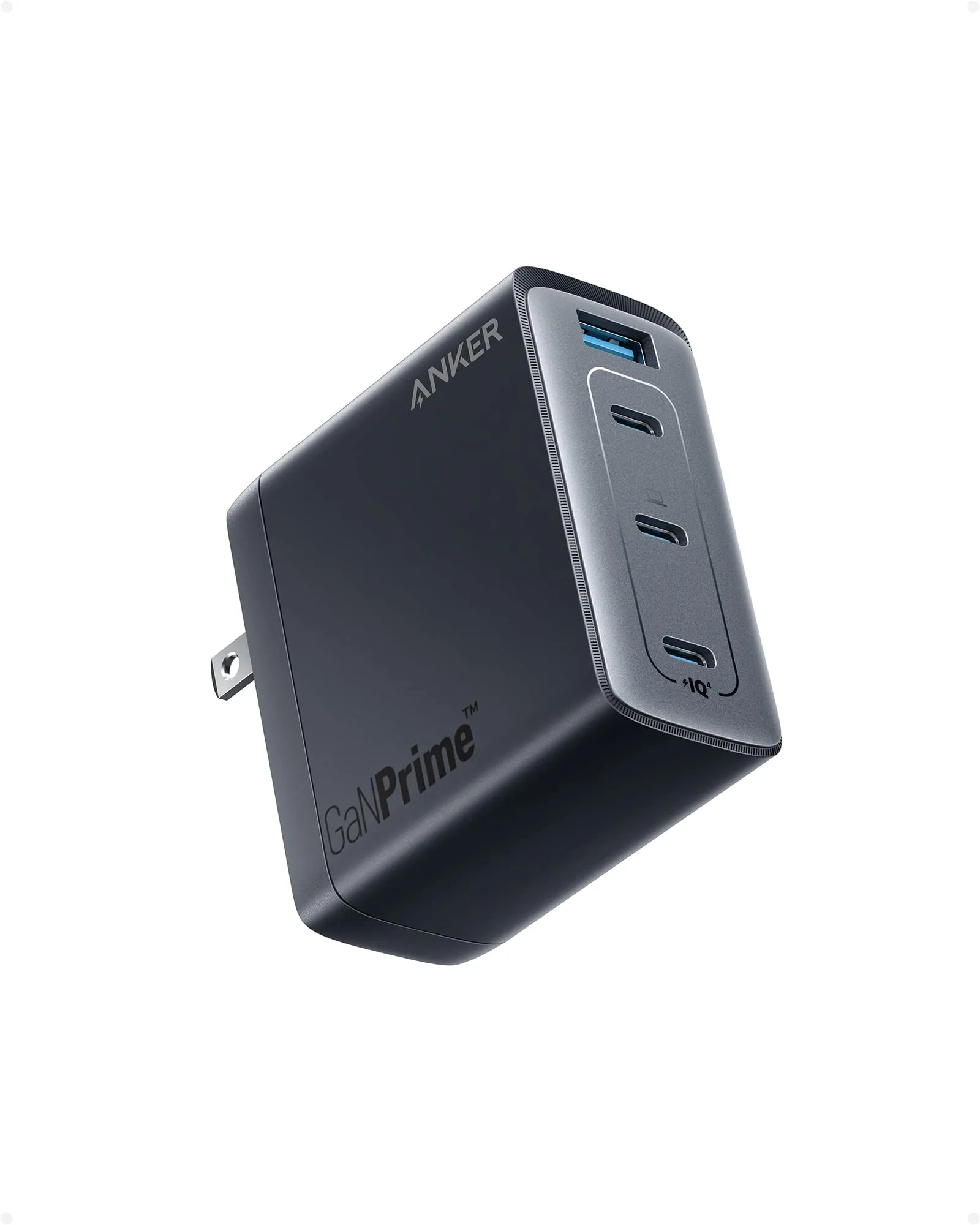
The Anker 747 (GaNPrime 150W) Charger is designed to eliminate this clutter entirely. It is not just a “spare” charger; it is intended to be a complete replacement for your laptop charger and every other adapter you carry. By utilizing Gallium Nitride (GaN) technology, Anker has squeezed 150 watts of power—enough to fast-charge two laptops simultaneously—into a block slightly smaller than a standard Apple MacBook charger.
But condensing high voltage into a small space comes with challenges: heat, weight, and power distribution complexity. In this review, we break down whether the Anker 747 delivers on its promise of being the ultimate “one-bag” charging solution.
2. Key Features Explained Simply
The marketing terms “GaNPrime” and “PowerIQ 4.0” sound impressive, but here is what they actually mean for your daily usage.
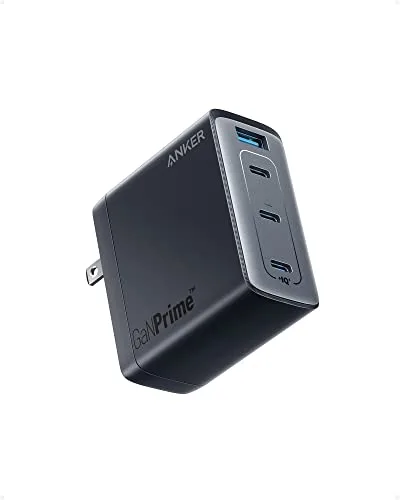
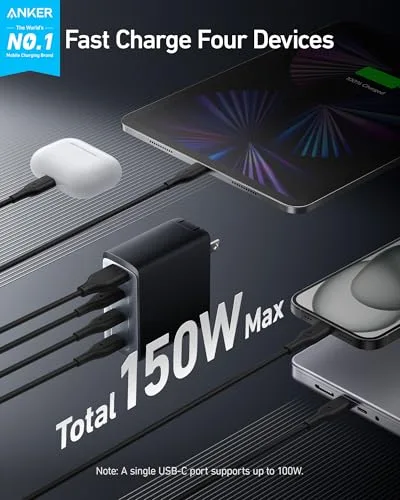
150W Total Output / 100W Max Single Port
The Benefit: The headline “150W” is the total budget the charger can split among its four ports. Crucially, the top two USB-C ports can output up to 100W individually. This means it can power a 16-inch MacBook Pro, a Dell XPS 15, or a ThinkPad X1 Extreme at full speed.
The Limitation: You cannot get 150W from a single port. The max for any one device is 100W. Also, to get that speed, you must use a USB-C cable rated for 100W (5A). Standard cables will throttle the speed to 60W.
Compact GaNPrime Architecture
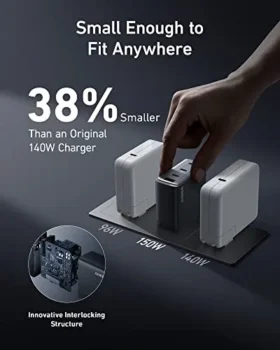
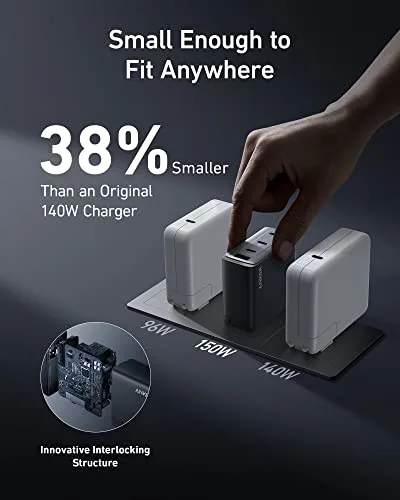
The Benefit: By using GaN (Gallium Nitride) semiconductors instead of silicon, Anker has increased efficiency and reduced heat. This allows components to be packed tighter. The result is a 4-port charger that is roughly 38% smaller than Apple’s single-port 140W brick.
The Limitation: Density equals weight. While small, this brick is heavy (approx. 230g). It feels like a dense stone in your hand.
PowerIQ 4.0 Dynamic Distribution
The Benefit: Older multi-port chargers had fixed splits (e.g., Port 1 is always 60W, Port 2 is always 30W). PowerIQ 4.0 actively checks what your devices need. If your laptop is full and just idling, the charger diverts that unused power to your phone or tablet to charge them faster. It updates this allocation every 3 minutes.
3. Hands-On Use & Performance
We tested the Anker 747 in a typical remote work scenario: a coffee shop with a loose wall outlet and a full suite of Apple gear.
The “Sag” Factor and the Silicone Stabilizer
Because the charger is compact but heavy, it has a tendency to pull away from loose wall sockets, especially when the prongs are folded out. Anker anticipated this. The box includes a silicone stabilizer (a suction-cup-like sleeve). While it looks a bit odd, it is functionally brilliant. It creates friction against the wall plate, keeping the heavy brick firmly plugged in even with four cables dragging it down.
Thermal Performance
Does it get hot? Yes. When pushing 140W-150W of total load (e.g., charging two laptops), the unit gets quite warm to the touch. However, Anker’s ActiveShield 2.0 monitors temps 3 million times a day. In our testing, the charger never reached dangerous temperatures; it simply throttled power slightly to stay within safe limits.
The “Handshake” Pause
Users should be aware of the “renegotiation pause.” When you are charging a laptop and you plug in a phone, the power cuts to the laptop for about 1-2 seconds before resuming. This is normal behavior—the charger is recalculating the safety limits for the new device. It is not a defect, but it can be annoying if you have a device with a sensitive battery notification sound.
4. Pros and Cons Table
| ✅ The Pros | ❌ The Cons |
|---|---|
| Massive Power: 150W total is enough to fast-charge two laptops (e.g., MacBook Air + MacBook Pro) at once. | Weight & Physics: It is dense and heavy. Without the stabilizer, it may fall out of loose airline or hotel sockets. |
| Travel Ready: Replaces 3-4 separate bricks, saving significant volume in your backpack. Prongs fold flat. | Price: It is significantly more expensive than standard chargers. You are paying a premium for GaN tech. |
| Intelligent Splitting: PowerIQ 4.0 ensures power isn’t wasted on fully charged devices, speeding up others. | Cable Not Included: For the price, the lack of an included 100W USB-C cable is a disappointment. |
| Safety First: ActiveShield 2.0 provides peace of mind when leaving devices plugged in overnight. | Fingerprint Magnet: The glossy finish around the ports scratches easily and collects smudges instantly. |

5. Comparison: How Does It Stack Up?
Is the 150W version necessary, or can you save money with a smaller model?
| Main Product Anker 747 (GaNPrime) |
Alternative UGREEN Nexode 140W |
Budget Option Anker 735 (GaNPrime) |
|---|---|---|
| 🔧 Key Features 150W Total, 4 Ports (3C+1A) |
🔧 Key Features 140W Total, 3 Ports (2C+1A) |
🔧 Key Features 65W Total, 3 Ports (2C+1A) |
| 👍 Pros Max power density, charges 4 items |
👍 Pros Slightly cheaper, PD 3.1 support |
👍 Pros Very small, affordable |
| 👎 Cons Expensive, heavy on wall |
👎 Cons Fewer ports, bulky shape |
👎 Cons Not for big laptops |
| 📐 Dimensions Compact Brick |
📐 Dimensions Square Block |
📐 Dimensions Candy Bar Sized |
| 🔋 Battery Life N/A (Wall Charger) |
🔋 Battery Life N/A (Wall Charger) |
🔋 Battery Life N/A (Wall Charger) |
| 🛡 Durability High (Dense plastic) |
🛡 Durability High (Matte finish) |
🛡 Durability High |
| 💲 Price Range $$$$ (Premium) |
💲 Price Range $$$ (High) |
💲 Price Range $$ (Mid-Range) |
| 🎯 Best-Use Scenario Power Users & Dual Laptops |
🎯 Best-Use Scenario MacBook Pro 16″ Users |
🎯 Best-Use Scenario MacBook Air & Phone |
6. Who Should Buy This?
The Anker 747 is an investment piece. It makes sense for:
- The “One-Bag” Traveler: If you travel with a laptop, iPad, phone, and watch, this single brick handles them all. It frees up space in your dopp kit or tech pouch.
- The Dual-Laptop Professional: If you carry a work laptop and a personal laptop (e.g., a PC and a Mac), this is one of the few chargers that can keep both running under load simultaneously.
- The Desk Minimalist: If you want to remove the power strip from under your desk and have a single, neat block on the desktop to handle all peripherals.
Who should skip it? If you only carry a MacBook Air (which uses 30W) and an iPhone, the Anker 747 is overkill. You are paying for 100W of headroom you will never use. The Anker 735 (65W) is a better fit for you.

7. Comparison Summary
The UGREEN Nexode 140W is a strong competitor and often slightly cheaper. It supports the newer PD 3.1 standard (140W single port), which the Anker 747 does not (100W max single port). However, the Anker 747 is more compact and offers 4 ports vs. UGREEN’s 3.
The Anker 735 (65W) is the “Lite” version. It uses the same GaNPrime tech but is half the size and weight. It is perfect for ultrabooks and phones but will struggle to charge a Pro laptop while you are using it.
8. Final Verdict
The Anker 747 Charger (GaNPrime 150W) is currently the gold standard for portable power consolidation. While the price is steep, the value comes from the sheer utility of replacing 3 or 4 other chargers with a single, reliable unit.
The inclusion of the silicone stabilizer proves that Anker understands the real-world physics of using heavy wall chargers, and the PowerIQ 4.0 distribution works flawlessly to keep multiple devices juiced up.
If you are tired of “charger anxiety” and want the most power in the smallest package possible, this is the charger to buy.

Read more articles on this topic: Charger.