Odvex.Admin
Welcome to Odvex, your trusted source for honest product reviews and buying guides.
The modern reliance on electronic devices has created a persistent need for portable power, yet most solutions are designed with inherent obsolescence. Traditional lithium-ion power stations typically degrade significantly after 500-800 charge cycles, often requiring replacement within 2-3 years of regular use. The Anker 521 Portable Power Station represents a fundamental shift in this paradigm, engineered not as a disposable accessory but as a durable asset with a measurable lifespan.
Utilizing Lithium Iron Phosphate (LiFePO4) battery chemistry, the Anker 521 is designed around the principle of total cost of ownership. While its initial price point may be higher than comparable-capacity NMC (Nickel Manganese Cobalt) battery units, its rated lifespan of over 3,000 charge cycles translates to a decade or more of reliable service for the average user. This review provides a technical and practical analysis of the Anker 521 PowerHouse, examining how its design choices prioritize longevity, safety, and sustained performance for critical applications.
Technical Architecture and Core Technologies
The performance profile of the Anker 521 is the direct result of specific engineering decisions. Understanding these underlying technologies is essential for evaluating its suitability for long-term applications.
LiFePO4 Battery Chemistry: The Foundation of Longevity
The centerpiece of the Anker 521 is its LiFePO4 (Lithium Iron Phosphate) battery. This chemistry differs fundamentally from the more common NMC batteries found in most consumer electronics. Key advantages include:
- Extended Cycle Life: Rated for 3,000+ full charge cycles while maintaining at least 80% of original capacity. For context, using the station once per week, this equates to over 57 years of service before significant degradation.
- Enhanced Thermal Stability: The phosphate-based cathode material is inherently more resistant to thermal runaway, making it significantly safer, especially during high-stress operations or in elevated ambient temperatures.
- Consistent Voltage Output: LiFePO4 batteries exhibit a flatter discharge curve than NMC, meaning devices receive more stable voltage throughout the battery’s discharge cycle, leading to potentially better performance for sensitive electronics.
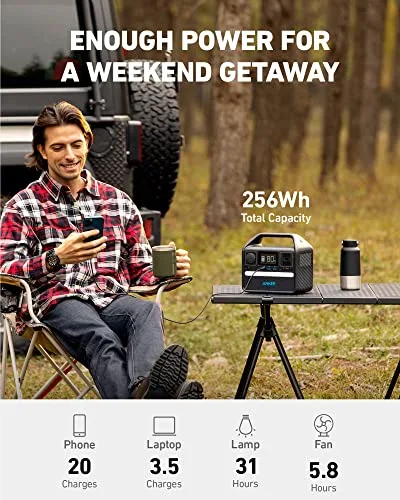
The trade-off for these benefits is energy density. LiFePO4 cells are physically larger and heavier for the same energy capacity (Wh) than NMC cells. Anker’s design manages this by targeting a 256Wh capacity, creating a portable unit (7.9 lbs / 3.6 kg) that remains manageable while delivering exceptional durability.
Power Delivery and SurgeCapability
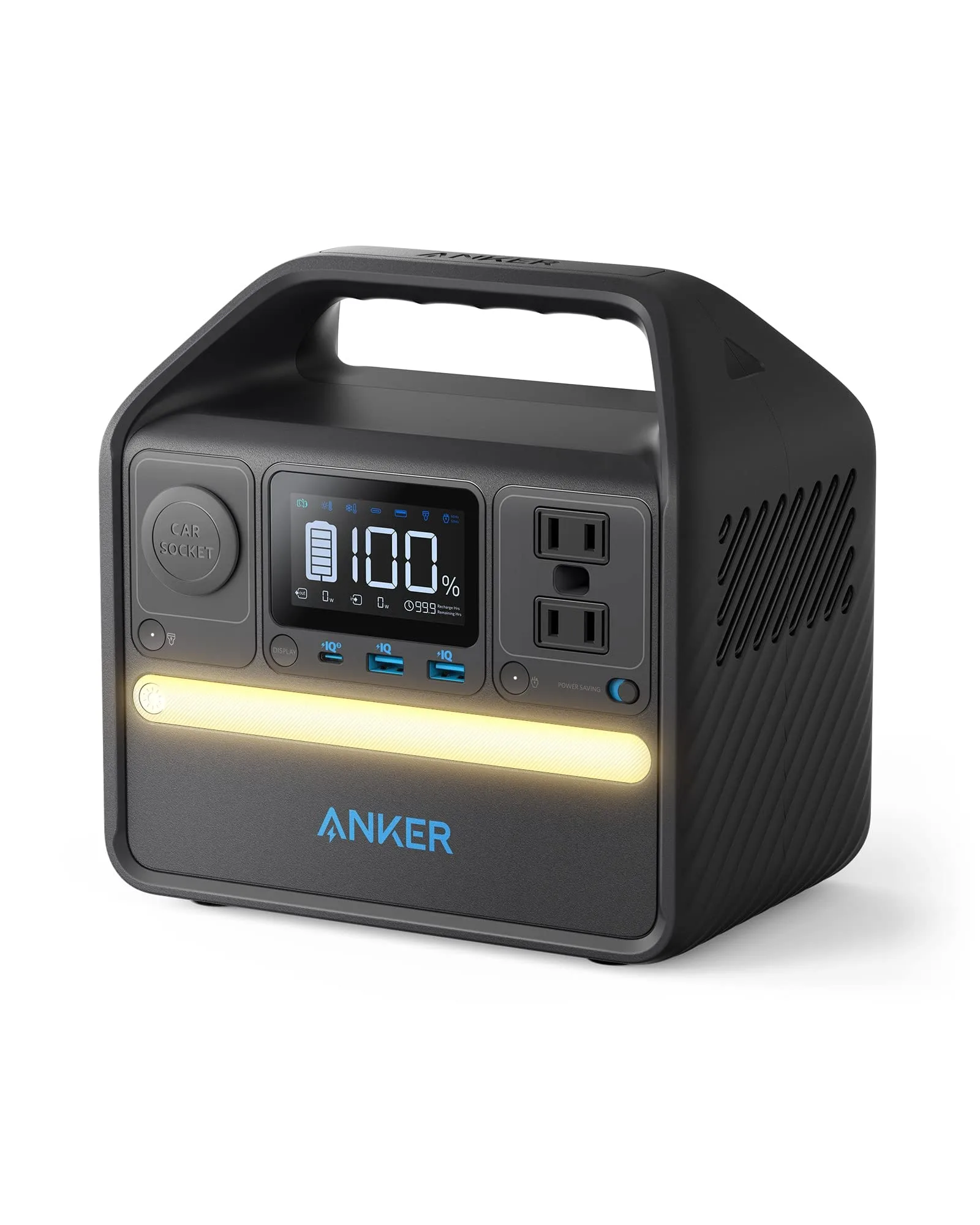
The unit provides 300 watts of continuous pure sine wave AC output via two standard 120V outlets. Pure sine wave output is crucial for the safe operation of devices with AC motors (like fans) and sensitive electronics, as it replicates the smooth waveform of grid power.
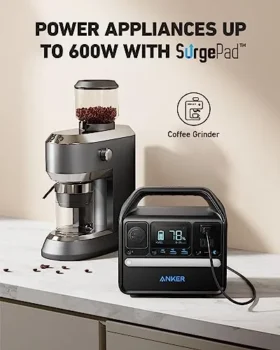
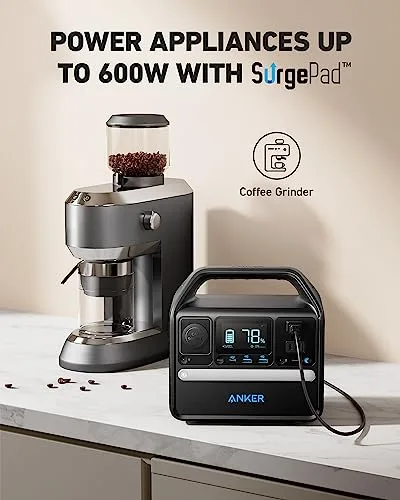
Anker’s SurgePower technology allows the inverter to temporarily deliver up to 600 watts to handle the startup surge (inrush current) required by inductive loads. This enables it to power small appliances like mini-fridges, corded power tools, or travel hair dryers that might have a surge requirement above 300W but run continuously at a lower wattage.
The front panel includes a comprehensive port selection:
- AC Outlets (x2): 300W continuous (600W surge), 120V pure sine wave.
- USB-C PD Port: 60W maximum output, capable of charging most modern laptops (e.g., MacBook Pro 13″, Dell XPS 13).
- USB-A Ports (x2): Standard 5V/2.4A (12W) output.
- USB-A Quick Charge Port: Supports Quick Charge 3.0 protocol (18W max).
- 12V DC Car Port: 12V/10A (120W max), suitable for portable coolers, tire inflators, or 12V lighting.
Battery Management and Safety Systems
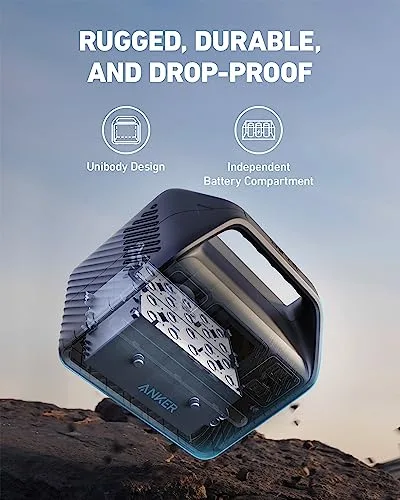
The Battery Management System (BMS) is a critical component for safety and longevity. The Anker 521’s BMS provides multiple layers of protection:
- Over-Charge/Discharge Protection: Prevents cell voltage from exceeding safe limits.
- Temperature Control: Monitors internal temperature and will throttle charging or output in extreme conditions.
- Short-Circuit Protection: Instantly cuts output if a fault is detected.
- Over-Current Protection: Prevents damage from devices drawing more power than the port’s rating.
The unit features a clear digital display showing remaining battery percentage, input/output wattage, and estimated runtime—a valuable feature for power management during outages or trips.
Real-World Performance and Application Scenarios
Practical Capacity and Runtime Calculations
The 256Wh (Watt-hour) capacity provides a concrete amount of energy. Runtime for any device can be calculated using the formula:
The 0.85 factor accounts for ~15% efficiency loss in the DC-to-AC conversion process.
Common Device Runtimes (Approximate):
- 60W Laptop: ~3.6 hours
- 10W LED Lamp: ~21.7 hours
- 35W CPAP Machine (without humidifier): ~6.2 hours
- 8W Router/Modem: ~27.2 hours
- 50W Portable Refrigerator (cycling): 4-8 hours (depending on cycle duty)
It can recharge a smartphone (15Wh) approximately 14-16 times or a tablet (30Wh) 7-8 times.
Recharging Methods and Timelines
The Anker 521 supports three primary recharging methods, each with different timeframes:
| Method | Charger/Source | Approximate Time (0-100%) | Notes |
|---|---|---|---|
| Wall Outlet | Included 100W AC Adapter | ~2.5 – 3 hours | Fastest method. Utilizes Anker’s proprietary fast-charge protocol. |
| Solar Panel | 100W+ Compatible Panel | ~3 – 6 hours | Depends on panel wattage and solar conditions. Supports up to 100W solar input. |
| 12V Car Outlet | Optional Car Charger | ~4 – 5 hours | Convenient for topping up while traveling. |
Long-Term Value Proposition and Warranty
The 5-year full warranty provided by Anker is exceptionally rare in the portable power market, where 1-2 year warranties are standard. This warranty reflects the company’s confidence in the LiFePO4 battery’s longevity and the overall build quality of the unit.
From a total cost of ownership perspective, a user who purchases a $150 NMC power station that degrades after 3 years would spend $450 over 9 years (assuming replacement every 3 years), not accounting for inflation or model changes. The Anker 521, while potentially costing more upfront, is engineered to provide reliable service throughout that entire period with minimal capacity loss, representing both economic and environmental efficiency.
Comprehensive Analysis: Capabilities and Constraints
| Primary Advantages | Key Limitations & Considerations |
|---|---|
| Decade-Scale Durability: LiFePO4 chemistry provides 3,000+ cycle life, fundamentally changing the product lifecycle from consumable to durable good. | Power Ceiling for Appliances: 300W continuous output excludes most kitchen appliances (microwaves, coffee makers, toasters) and full-size refrigerators. |
| Industry-Leading Warranty: The 5-year warranty provides exceptional long-term consumer protection and reflects build quality confidence. | Capacity for Extended Outages: 256Wh is sufficient for personal electronics and medical devices but may require careful management for multi-day home outages without recharging. |
| True 60W USB-C PD: Can power and fast-charge most productivity laptops, eliminating the need to carry a separate laptop charger. | Solar Panel Optional: To function as a complete solar generator, a compatible 100W+ solar panel must be purchased separately, increasing the total system cost. |
| SurgePower Functionality: 600W surge capability allows it to start and run motor-driven devices that would trip a standard 300W inverter. | Weight vs. Capacity Ratio: At 7.9 lbs, it is heavier than some NMC units of similar capacity due to the denser LiFePO4 cells, a trade-off for longevity. |
Market Comparison: Positioning the Anker 521
The following comparison illustrates how the Anker 521 fits within the broader portable power station market, highlighting key trade-offs between chemistry, capacity, and cost.
| Specification | Anker 521 PowerHouse (LiFePO4 Focus) |
Mid-Capacity NMC Station (Budget Balance) |
High-Capacity LiFePO4 (Power & Longevity) |
|---|---|---|---|
| Battery Chemistry | Lithium Iron Phosphate (LiFePO4) | Lithium-ion (NMC) | Lithium Iron Phosphate (LiFePO4) |
| Energy Capacity | 256 Wh | 300 – 500 Wh | 500 – 1000 Wh |
| Cycle Life (to 80%) | 3,000+ cycles | 500 – 800 cycles | 3,000+ cycles |
| AC Output (Continuous) | 300W (600W Surge) | 300W | 600W – 1000W |
| Unit Weight | 7.9 lbs (3.6 kg) | 5.5 – 7 lbs (2.5 – 3.2 kg) | 12 – 25 lbs (5.4 – 11.3 kg) |
| Warranty Period | 5 Years | 1 – 2 Years | 2 – 5 Years |
| USB-C PD Power | 60W | 45W – 60W | 60W – 100W |
| Ideal Use Case | Long-term personal/medical backup, frequent weekend use, remote work. | Occasional recreational use, budget-conscious buyers, light backup. | Extended off-grid trips, home emergency backup for small appliances. |
Target User Profiles and Recommendations
The Anker 521 is optimally suited for users whose priorities align with its core strengths of durability, safety, and reliable mid-range power.
Not Recommended For: Users who primarily need to power high-wattage appliances (≥800W) like microwaves or space heaters, or those who require multi-day, whole-house backup without recharging opportunities. These needs demand higher-capacity, higher-output units.
Final Assessment: A Paradigm Shift in Personal Power
The Anker 521 Portable Power Station is a thoughtfully engineered product that successfully redefines value in the personal power market. By adopting Lithium Iron Phosphate chemistry and backing it with an unprecedented 5-year warranty, Anker has shifted the focus from initial cost to long-term utility and total cost of ownership.
Its 256Wh capacity and 300W output are carefully chosen to match the needs of powering modern personal electronics, small appliances, and critical medical devices, while keeping the unit portable and within a reasonable price bracket for a premium chemistry. The inclusion of a full-power 60W USB-C PD port and SurgePower technology demonstrates attention to real-world user needs.
While not the solution for every power scenario, the Anker 521 establishes a new benchmark for durability and reliability in its class. For users who view a power station as a long-term investment rather than a disposable commodity, it represents one of the most technically sound and economically rational choices available. It delivers not just power, but the peace of mind that comes from a product engineered to last.
Read more articles on this topic: Battery.