Odvex.Admin
Find exactly what you need with the comprehensive reviews and guides at Odvex.
Introduction: The Budget Monitor Conundrum
True studio monitors are tools of revelation, designed to expose every detail—and flaw—in a recording with ruthless accuracy. This professional-grade performance traditionally comes at a professional-grade price, putting it out of reach for bedroom producers, podcasters, and discerning listeners. The Edifier MR4 enters the market with a provocative promise: to deliver a “near-flat responsive curve” and “true studio monitor” performance at a fraction of the cost. But can a sub-$150 pair of speakers genuinely offer the neutral, analytical sound required for critical work, or is the “studio monitor” label merely clever marketing for what are essentially good-sounding bookshelf speakers? This review scrutinizes the MR4’s performance where it matters most: in the critical listening sweet spot.
Features: Designed for Accuracy (and Compromise)
The MR4’s specifications reveal a clear intent to serve both the aspiring creator and the quality-focused listener, with features that prioritize control and flexibility.
- Near-Flat Frequency Response: This is the core promise. A “near-flat” curve means the speaker adds minimal coloration, aiming to reproduce sound as it was recorded. The benefit for creators is accurate mixing decisions; for listeners, it’s hearing music the way the artist intended.
- Dual Modes (Monitor & Music): This is a pragmatic admission of the monitor’s limitation. “Monitor Mode” aims for maximum flatness for critical work. “Music Mode” introduces a gentle, listener-friendly EQ curve (often a slight bass/treble boost) to make casual listening more enjoyable—a smart feature for dual-purpose use.
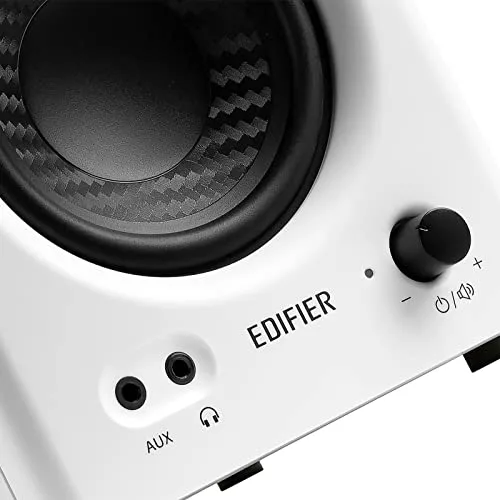
- Professional Connectivity (1/4″ TRS): The inclusion of a balanced TRS input alongside standard RCA and 3.5mm is a significant nod to its studio aspirations. Balanced connections reduce noise over longer cable runs, which is essential in a professional setup connecting to an audio interface.
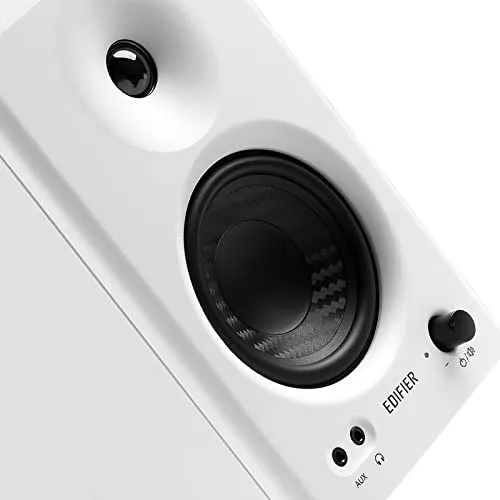
- Dedicated Tone Controls & Front-Panel Headphone Out: The separate high-frequency and low-frequency adjustment knobs allow for room calibration to combat acoustic issues. The front-panel headphone jack with its own volume knob is an incredibly thoughtful feature for quick, private checking of mixes.
- MDF Cabinet Construction: The Medium-Density Fibreboard enclosures are standard for monitors at any price to minimize unwanted resonance, ensuring the sound comes from the drivers, not vibrating panels.
Hands-On Experience: In the Producer’s Chair
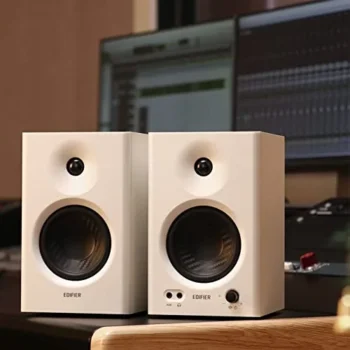
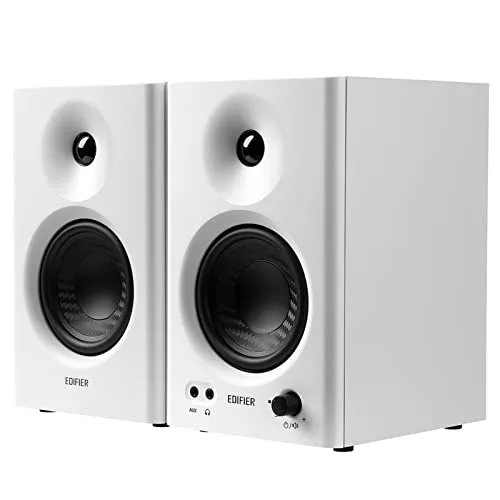
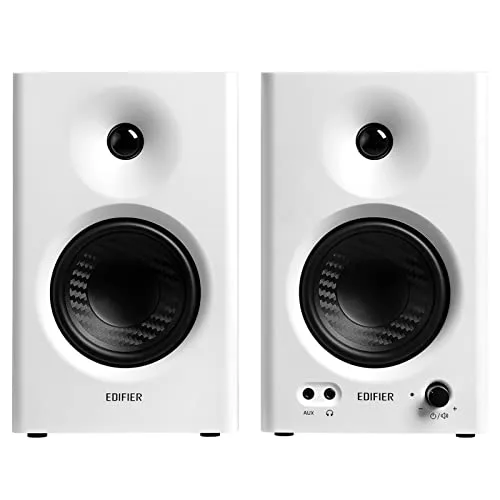
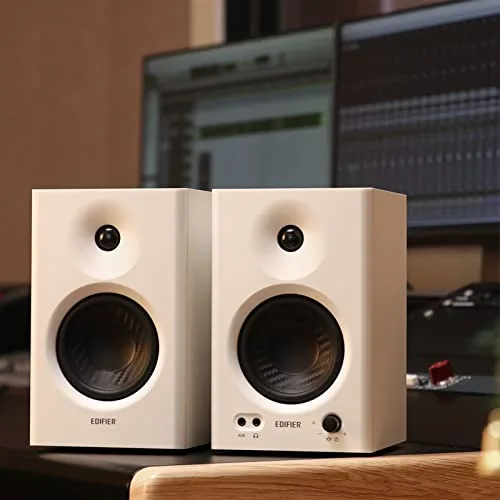
The MR4s have a clean, modern aesthetic. The white finish and slanted baffle design give them a professional look suitable for a desk. Setup is straightforward: connect the passive speaker to the active one, then connect your source. For optimal performance, placement on speaker stands or isolation pads is highly recommended to decouple them from the desk.
The Sound Test: Monitor Mode vs. Music Mode: In Monitor Mode, the MR4s live up to their “near-flat” claim remarkably well for the price. The sound is detailed, clean, and impressively balanced. The 1-inch silk dome tweeter delivers smooth highs without harshness, while the 4-inch woofer provides a tight, controlled mid-bass. The stereo imaging is precise, allowing you to pinpoint instruments in the mix. However, the compromise is clear: the low-end extension rolls off predictably below ~60Hz. You won’t feel sub-bass; you’ll hear a representation of it. This is not a flaw but a physical limit of the driver size and cabinet.
Switching to Music Mode introduces a subtle but noticeable warmth. The bass gains a touch more body and the highs a slight sparkle, making playlists and podcasts more engaging for leisure listening. It’s a well-implemented feature that doesn’t turn the speakers into a bass-heavy mess.
The Creator’s Workflow: For mixing and editing, the MR4s are revelatory compared to consumer speakers or headphones. They reveal imbalances in a mix, sibilance in vocals, and muddiness in the low-mids with surprising clarity. The TRS input from an audio interface worked flawlessly with no noise. The front headphone jack became an instant favorite for A/B checking mixes.
The Critical Limitations: These are near-field monitors. Their sweet spot is small—they sound best when you’re sitting directly in front of them. They are not for filling a living room with party sound. The lack of deep bass means electronic music producers or those working on film scores will need to supplement with headphones or a subwoofer to make decisions about the lowest frequencies.
Pros and Cons: The Honest Trade-Offs
| Pros | Cons |
|---|---|
| Remarkably flat and accurate sound for the price (Monitor Mode) | Limited low-frequency extension (no deep bass) |
| Useful dual-mode design for work and leisure | Best performance is in a small, near-field listening sweet spot |
| Professional features (TRS input, front headphone out, tone controls) | Requires careful placement (stands/isolation pads recommended) |
| Excellent value for aspiring producers and audiophiles | Power output is sufficient for desktop use, not for large rooms |
| Clean, modern design with solid MDF build | No Bluetooth or digital inputs (purely analog, by design) |
How It Stacks Up: The Entry-Level Monitor Arena
| Criteria | Edifier MR4 | Competitor: PreSonus Eris E3.5 | Budget: Mackie CR3-X |
|---|---|---|---|
| Price Point | Budget | Budget | Ultra-Budget |
| Key Strength 🎯 | Accuracy & Features (TRS, Dual Mode) | Established Brand & Acoustic Tuning | Lowest Price of Entry |
| Sound Character 🔊 | Neutral, Detailed, Flat (in Monitor Mode) | Balanced, Slightly Warm | Colored, Bass-Forward |
| Inputs 🔌 | TRS, RCA, 3.5mm, Headphone Out | TRS, RCA, 3.5mm, Headphone Out | RCA, 3.5mm |
| Best For | Aspiring producers & critical listeners wanting the most accuracy | Beginners wanting a trusted brand name | Casual users wanting “monitor-style” speakers on a razor budget |
The MR4 distinguishes itself with its effective dual-mode feature and a strong commitment to neutrality. The PreSonus Eris E3.5 is a direct competitor with a similar goal. The Mackie CR3-X is more of a consumer speaker with monitor styling, lacking true flat response.
Product Images
Final Verdict: A Gateway to Professional Sound
The Edifier MR4 is a triumph of value-oriented engineering. It successfully delivers on its core promise of providing a genuine, near-flat monitoring experience at an accessible price point. For the bedroom producer, podcaster, or audiophile seeking uncolored sound, it is a game-changer, offering insights into your audio that typical consumer speakers simply cannot.
Its limitations—lack of deep bass and a focused sweet spot—are not failures but inherent characteristics of its design category and price. The brilliant dual-mode feature thoughtfully bridges the gap between critical work and enjoyable listening.
If you need thunderous bass for EDM listening sessions or a speaker to fill a large living room, look elsewhere. But if your goal is accurate, detailed sound for creation or critical enjoyment at your desk, the Edifier MR4 sets a new benchmark for what’s possible under $150. It’s not just a good budget speaker; it’s a legitimate professional tool.
Read more articles on this topic: Speaker.