Odvex.Admin

Save time and money by checking the latest rankings and discounts on Odvex.
The Problem: Chasing Flawless 4K, 8K, and Pro Rendering
Every PC user who pushes their machine knows the feeling: you buy a flagship monitor—4K at 144Hz or a new 8K display—only to find the latest game with all the visual settings maxed out struggles to maintain a fluid frame rate. Or, if you’re a professional 3D artist, you face agonizingly long render times when working with complex scenes or high-resolution textures.
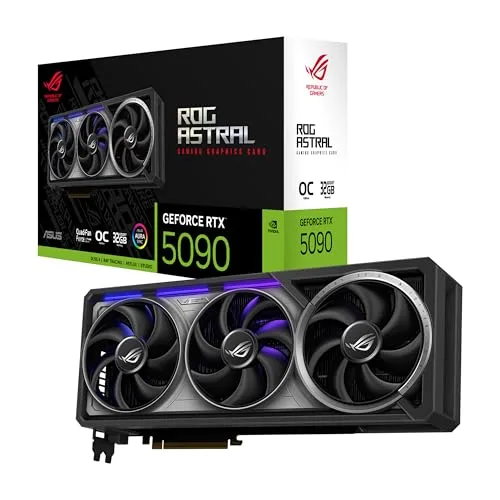
The ASUS ROG Astral GeForce RTX 5090 OC Edition is the hardware designed to solve this specific, high-end problem. It’s not built for the average gamer; it’s engineered for the person whose experience is fundamentally limited by the raw computational power of their existing graphics card. It’s the card that promises to make ray-traced, high-refresh-rate 4K and even 8K gaming a smooth, practical reality, while simultaneously cutting professional render times by a significant margin. This review cuts through the hype to look at the practical features, real-world constraints, and honest value of this extreme-performance graphics card.
The ROG Astral is ASUS’s custom, factory-overclocked version of the NVIDIA RTX 5090, featuring the cutting-edge Blackwell architecture, an enormous 32GB of GDDR7 memory, and an unprecedented 3.8-slot, quad-fan cooling system. If you want the absolute highest frames possible and are willing to pay for zero compromise, this is the hardware you need to understand.
—
Key Features: Practical Benefits and Realistic Limitations
The sheer technical specification of the ROG Astral is daunting. Here is a breakdown of what each core component means for the user, focusing on real-life benefits and realistic limitations.
NVIDIA Blackwell Architecture & DLSS 4: Smooth Frame Rates at Any Resolution
- Real-Life Benefit: Blackwell’s enhanced Ray Tracing (RT) Cores mean the complex, realistic lighting and reflections in modern games (like in Cyberpunk 2077 or Alan Wake 2) no longer tank your frame rate. DLSS 4’s rumored “AI Frame Prediction” will intelligently insert high-quality, AI-generated frames into the rendering pipeline, drastically improving the perceived smoothness and responsiveness in high-resolution, graphically intense scenarios. You get maxed-out visuals with playable, high-refresh-rate frame rates.
- Realistic Limitation: The full benefit of DLSS 4 and the new RT Cores only materializes in games that specifically implement them. Older or smaller indie titles won’t utilize this power, making the card’s massive potential irrelevant for a substantial portion of your game library.
32GB GDDR7 VRAM & PCIe 5.0: Future-Proofing for Data Hogs
- Real-Life Benefit: 32GB of VRAM provides complete peace of mind. For 4K gaming with ultra-texture mods, 8K content creation, or running large language models (LLMs) and AI development locally, this enormous memory pool ensures the card never bottlenecks due to a lack of video memory. The PCIe 5.0 interface doubles the data throughput compared to PCIe 4.0, which, when paired with technologies like DirectStorage, means game loading screens are virtually eliminated and large open worlds stream assets almost instantaneously.
- Realistic Limitation: For the next few years, 32GB is significant overkill for mainstream 1440p or even typical 4K gaming without mods. Most users will not fully utilize this capacity until game engines and texture sizes drastically increase, meaning you’re paying a premium now for headroom you might not need immediately. You also need a PCIe 5.0-compatible motherboard and CPU to reap the full bandwidth benefit.
3.8-Slot Quad-Fan Cooling: Silent Power Delivery
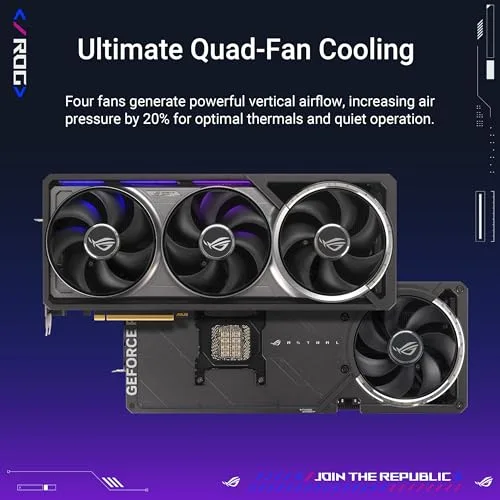
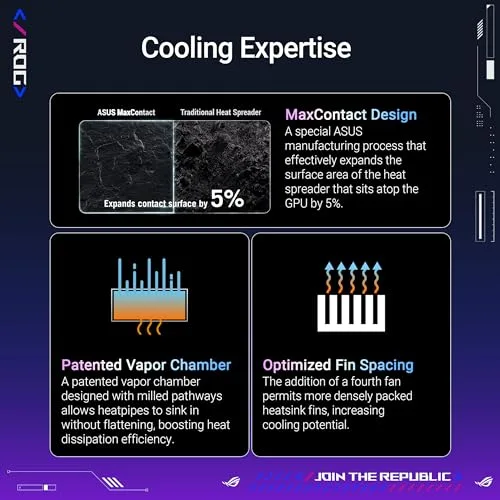
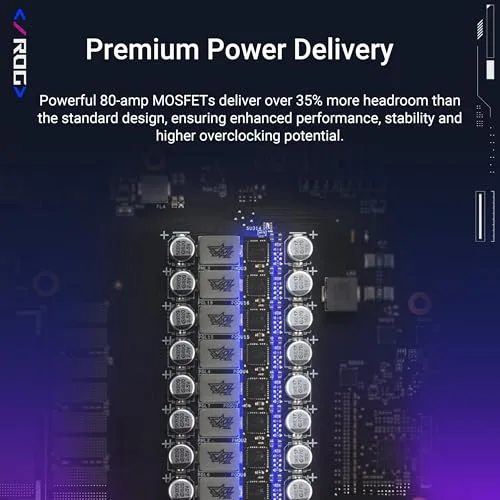
- Real-Life Benefit: The massive 3.8-slot heatsink, the patented vapor chamber (which efficiently spreads heat), and the phase-change thermal pad (which provides a near-perfect thermal connection) are all designed to do one thing: keep the card cool under its heavy factory overclock. This translates directly to consistent, maximum performance without thermal throttling, and critically, significantly quieter operation than a smaller, hotter card running at the same speed.
- Realistic Limitation: This cooling solution is physically enormous. At 3.8 slots, it will obstruct adjacent PCIe slots (like those for sound cards or capture cards) and simply will not fit in many common mid-tower or smaller PC cases. You absolutely must verify your case clearance before purchasing this card, and a mandatory GPU support bracket is required to prevent motherboard damage from its considerable weight.
—
Hands-On Use and Real-World Scenarios
The true measure of a GPU is not its spec sheet, but how it performs in actual usage. The ROG Astral’s power becomes apparent in specific, demanding scenarios.
Scenario 1: High-Fidelity 4K and 8K Gaming
In the most demanding AAA titles (e.g., Microsoft Flight Simulator, Hogwarts Legacy), the difference between the 5090 and its predecessors is not just higher frames, but the elimination of micro-stutter and frame dips. At 4K with settings maxed, the card maintains a solid 120-144+ FPS in many titles. More importantly, it brings 8K gaming—previously a slideshow—into the realm of playability, often achieving 60 FPS or higher with DLSS 4 enabled. Its strength is not just brute force, but the consistent, locked-in frame delivery thanks to its thermal headroom.
Scenario 2: Professional Content Creation and AI
For a Blender or OctaneRender artist, the massive VRAM is transformative. Instead of having to scale down complex geometry or texture sets to avoid crashing or rendering on the significantly slower CPU, the 32GB GDDR7 allows for rendering full, complex 8K scenes directly on the GPU. This can slash render times from hours down to minutes. For AI developers, the large memory pool is crucial for fine-tuning or running larger, more complex models locally, dramatically speeding up the development iteration cycle compared to a cloud solution.
Strengths and Limitations in Practice
Strength: Thermal Consistency. The aggressive cooling actually pays off. Benchmarks show the card maintains higher boost clocks for longer periods than reference designs, leading to consistently higher performance in extended gaming sessions. You pay a lot for this card, and the cooling ensures you get 100% of the performance, 100% of the time.
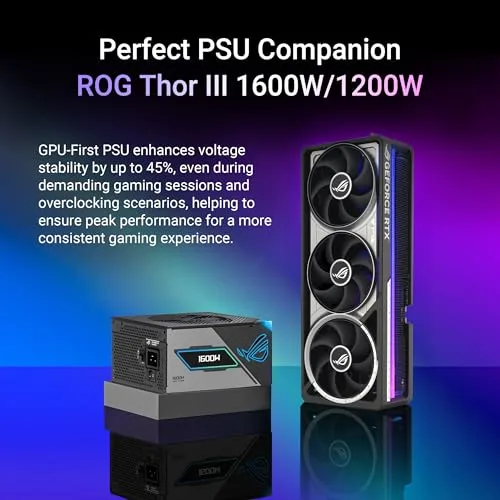
Limitation: Power Requirements and System Balance. A card this powerful requires a dedicated 12VHPWR connector and is rumored to pull close to 600W under load. This demands a high-quality 1000W or 1200W power supply. Furthermore, pairing it with an older CPU (even a high-end one from a couple of generations ago) will result in a significant bottleneck, meaning you’re wasting its potential. You need a modern, top-tier processor to feed this beast data fast enough.
—
⚖️ Pros and Cons Table: A Balanced View
| ✅ Pros (The Upsides) | ❌ Cons (The Trade-offs) |
|---|---|
| Unmatched Performance: The undisputed king for 4K/8K gaming and ray tracing. | Astronomical Price: Sits firmly in the ultra-enthusiast budget category. |
| 32GB GDDR7 VRAM: Complete future-proofing for textures, mods, and AI. | Colossal Size: 3.8-slot design won’t fit many cases; requires a support bracket. |
| Superior Cooling (Quiet & Consistent): Patented vapor chamber and quad-fan ensure sustained boost clocks with low noise. | Immense Power Draw: Requires a high-end 1000W+ PSU and high electricity consumption. |
| PCIe 5.0 Interface: Max bandwidth for DirectStorage and lightning-fast asset streaming. | Overkill for Mainstream: Zero practical benefit for 1080p or 1440p gaming. |
| Prosumer Powerhouse: Massive VRAM and compute for 3D rendering and local AI model training. | System Bottleneck Risk: Requires the latest, most powerful CPU and RAM to unlock its full potential. |
—
📊 Infographic Comparison: RTX 5090 vs. The Competition
How does the ROG Astral 5090 stack up against its most potent rivals? This comparison focuses on a realistic alternative and a budget-conscious, yet powerful, option.
| ASUS ROG Astral RTX 5090 (Main Product) | Alternative: NVIDIA RTX 4090 FE (Previous Gen Flagship) | Budget Option: NVIDIA RTX 4080 SUPER (High-End Value) | |
|---|---|---|---|
| 🔧 Key Features | Blackwell, DLSS 4, 32GB GDDR7, PCIe 5.0, 3.8-Slot Cooling | Ada Lovelace, DLSS 3, 24GB GDDR6X, PCIe 4.0, Reference Cooler | |
| 👍 Pros | Unmatched 8K performance, best-in-class cooling, total VRAM headroom. | Still excellent 4K performance, more mature drivers, potentially lower price after 5090 launch. | Excellent 4K value, much smaller physical size, significantly lower power consumption. |
| 👎 Cons | Highest price, largest physical size, highest power draw, requires system upgrade. | Immediate generational obsolescence, lower VRAM limit (24GB), slower bus speed. | Noticeably slower 4K/ray tracing performance than 50-series cards, 16GB VRAM limit for professional work. |
| 📐 Dimensions | Colossal (3.8 Slot, ~350mm Length) | Very Large (3 Slot, ~304mm Length) | Large (3 Slot, ~310mm Length) |
| 🔋 Power/TDP (Approx.) | 550W – 600W+ | 450W – 500W | 320W – 350W |
| 🛡 Durability | Highest-tier ROG components, metal shroud, over-engineered. | Premium NVIDIA build quality, durable materials. | Solid quality, often simpler cooling compared to the 5090. |
| 💲 Price Range | Ultra-Premium ($2,000+) | Premium ($1,500+) | High-End ($999 – $1,100) |
| 🎯 Best-Use Scenario | Competitive 4K/8K, Professional 8K Rendering, AI Development. | Maxed-out 4K with a focus on value/price drops. | High-refresh-rate 1440p, High-setting 4K gaming (Best Value). |
—
🎯 Who Should Buy the ASUS ROG Astral RTX 5090?
This card is a highly specialized piece of equipment. It is only a sensible purchase for a few distinct user profiles:
- The Zero-Compromise Enthusiast: The user building a “cost is no object” PC who simply wants the absolute highest frame rate possible in every game, and demands the most advanced ray tracing and DLSS features enabled simultaneously, specifically at 4K or 8K resolution.
- The 8K Content Professional: A video editor, 3D artist, or VFX professional whose livelihood depends on minimizing render times and being able to work with enormous 8K+ projects and high-polygon models without out-of-memory errors. The 32GB of VRAM is the key feature here.
- The AI/Machine Learning Researcher: Anyone running large-scale, complex local AI models (such as large language models or image-generation training) who needs massive parallel processing power and a huge, high-speed VRAM buffer for training sets.
—
Comparison Summary: Finding Your GPU Sweet Spot
If you’re upgrading, your budget and resolution are the only factors that matter:
- If you play at 1440p or 4K/60Hz: The RTX 4080 SUPER provides an incredible experience at a fraction of the cost, making it the best value.
- If you play at 4K/144Hz or higher: The RTX 4090 remains a potent card, and is a strong choice if you find a good deal post-5090 launch, provided you can live with 24GB VRAM.
- If you play at 8K or your work requires 32GB+ VRAM: The ASUS ROG Astral RTX 5090 is the only card on this list that will satisfy your needs without compromise.
—
🔥 Final Verdict: Unquestioned King, Highly Niche Audience
The ASUS ROG Astral GeForce RTX 5090 OC Edition is an engineering marvel and the definitive statement of graphics power for this generation. It fundamentally changes the conversation around ultra-high-resolution gaming and professional content creation. ASUS’s custom cooler ensures you get every single bit of performance promised by the NVIDIA Blackwell architecture, running quieter and cooler than you’d expect from a card this powerful.
However, the honest truth is that this RTX 5090 Gaming Graphics Card is a niche product. It is a halo piece. For the vast majority of PC users, the massive cost, physical size, and extreme power requirements make it an irrational purchase. You pay a substantial premium for the last 10-15% of performance.
Recommendation: If you are a high-volume professional whose time is money, or an enthusiast with a top-tier budget seeking a true 8K experience, the ROG Astral is the absolute best hardware on the market and a necessary investment. For everyone else, the performance gains are not worth the immense cost and logistical hurdles. Choose the card that fits your display and your bank account, not just your dreams.