Odvex.Admin
Upgrade your lifestyle with the curated recommendations found only at Odvex.
Let’s be honest: the biggest barrier to juicing isn’t the taste—it’s the prep work. I can’t tell you how many times I’ve looked at a bag of apples, thought about the 15 minutes of washing, coring, and slicing required to fit them into a standard juicer, and just grabbed a coffee instead.
That is exactly why this 400W Cold Press Juicer with a 5.8″ Feed Chute caught my attention. It promises to eliminate the chopping block entirely. The idea of dropping a whole apple or a handful of celery into a machine without bringing out a knife is appealing, but does a chute that big compromise the juice quality? I picked this up to see if it could actually handle the heavy lifting or if it would just jam up at the first sign of a carrot.
The Main Draw: Features That Matter
Before I get into how it performed in my kitchen, here is what makes this specific model stand out against the sea of other masticating juicers.
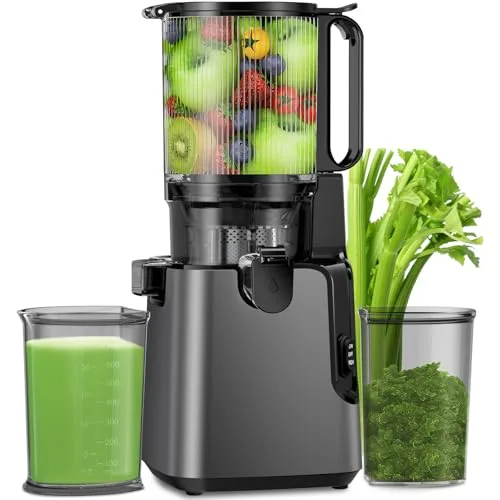
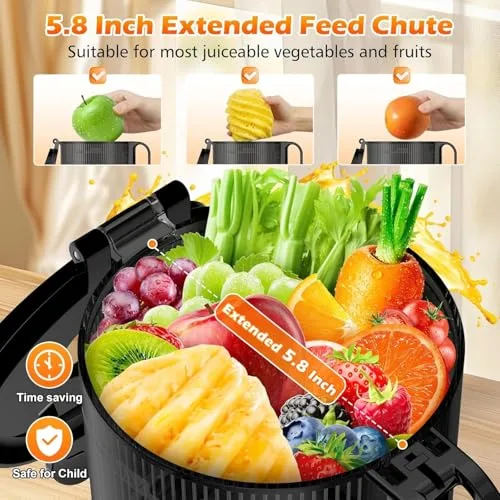
- The “Whole Fruit” Design: The 5.8-inch feed chute is the headline here. Most slow juicers have a small hole that barely fits a cucumber. This one is designed to take whole ingredients, which drastically cuts down prep time.
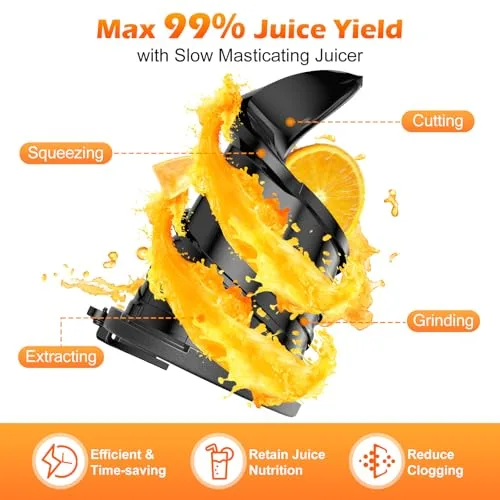
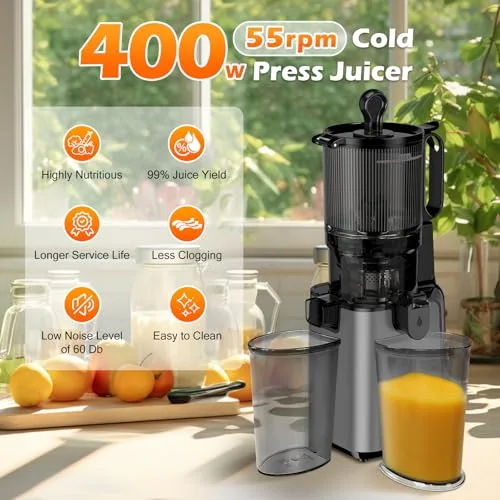
- High Torque, Low Speed: It runs on a 400W motor but spins at a slow 55 RPM. This is the sweet spot. You want the power to crush hard beets, but the slow speed to prevent heat buildup, which kills enzymes and makes juice separate/oxidize quickly.
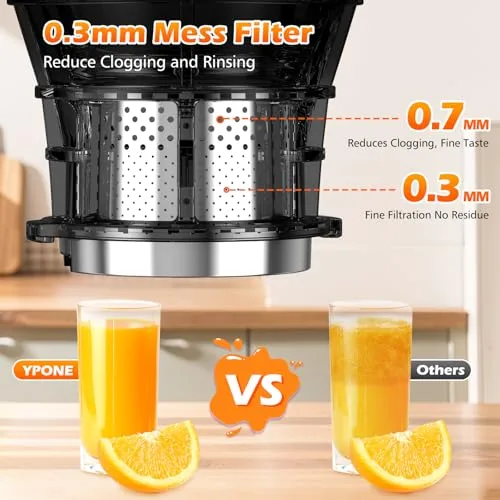
- Double Filtration: It uses dual strainers with a 0.3mm mesh. This is designed to separate the pulp from the liquid more effectively, aiming for that smooth, store-bought texture rather than a chunky smoothie.
- Simplified Assembly: The manufacturer claims it breaks down into 3 main parts for cleaning. If you have ever spent 20 minutes scrubbing a complex juicing screen, you know why this matters.
Hands-On Test: The Morning Rush
I decided to put this machine through a realistic “Monday Morning” stress test. I didn’t prep anything beforehand. I had whole apples, long stalks of celery, unpeeled ginger, and whole carrots.
The Whole Apple Test
I started with the apples. Usually, I have to quarter them. With this machine, I opened the flip-top lid (which has a safety lock, by the way) and dropped a medium-sized Honeycrisp apple in whole. I was expecting the motor to whine or the auger to jam, but the 400W motor just crunched right through it. It grabbed the apple, pulled it down, and juice started flowing almost instantly.
The Texture and Yield
The juice came out significantly cooler than what I get from my centrifugal juicer. Because it’s “chewing” the fruit rather than shredding it at high speeds, there was very little foam on top. I poured it into a glass and let it sit for 20 minutes to check for separation. It stayed emulsified, which is a good sign of a quality cold press.
The pulp coming out of the ejector was notably dry. It wasn’t dust-dry, but it was dry enough that I knew I wasn’t wasting money on produce.
Cleanup Time
This is where most juicers fail. I timed the cleanup. Disassembling the unit took about 15 seconds. It really is just three main components. The included brush is necessary for the metal mesh screen (fiber always gets stuck there), but because the parts are large, I didn’t have to hunt for hidden crevices. I had it rinsed and drying in the rack in under 3 minutes.
Pros and Cons
No appliance is perfect. Here is what I loved and what annoyed me during testing.
| What I Liked (Pros) | What Needs Work (Cons) |
|---|---|
| Huge Time Saver: Being able to skip chopping apples and pears is a luxury I didn’t know I needed. | Counter Space: This is a substantial machine. It has a large footprint and isn’t easy to tuck away in a cupboard. |
| Quiet Operation: You can run this while the family is asleep. It hums rather than screams. | Pulp Chute: Occasionally, stringy veggies like celery strings can hang up at the exit point if you don’t cut them at all. |
| Smooth Juice: The dual strainer system works. The juice is silky with very little sediment. | Price: It is an investment compared to cheap centrifugal spinners. |
| Safety Features: The lid lock ensures you can’t accidentally touch the auger while it’s moving. |
How It Compares
To give you a better idea of where this sits in the market, I compared it against a standard narrow-chute masticating juicer and a high-speed centrifugal option.
| Feature | This 400W Wide Chute Model | Standard Narrow Chute Slow Juicer | High-Speed Centrifugal Juicer |
|---|---|---|---|
| Prep Time ⏱️ | Fast (Whole fruits) | Slow (Lots of chopping) | Medium (Some chopping) |
| Noise Level 🔇 | Quiet (Low hum) | Quiet (Low hum) | Loud (Jet engine) |
| Nutrient Retention 🌿 | High (Cold press) | High (Cold press) | Low (Heat/Oxidation) |
| Feed Chute 🍎 | 5.8 Inches | 1.5 – 3 Inches | 3 Inches |
Verdict: Is It Worth It?
If you are looking to get into daily juicing but know that you are lazy about prep work (like me), the 400W Large Feed Chute Juicer is a fantastic upgrade. The ability to toss in whole produce changes the workflow completely. You go from a 20-minute ordeal to a 5-minute routine.
It creates high-quality, nutrient-dense juice that tastes better and lasts longer in the fridge than what you get from a high-speed spinner. While it takes up a bit of counter space, the time it saves you in the morning makes it a permanent fixture in my kitchen. It feels durable, handles hard vegetables with ease, and most importantly, it is easy enough to clean that you won’t dread using it.