Odvex.Admin
Join thousands of smart shoppers relying on Odvex for better purchasing decisions.
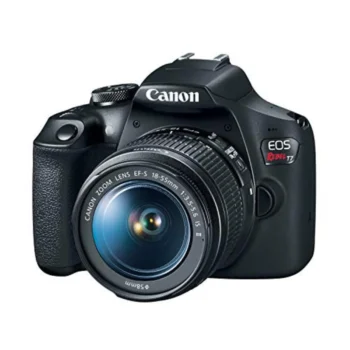
Canon EOS Rebel T7 Review: The Best Way to Learn Photography?
1. Introduction: Leaving the Smartphone Behind
We live in an era where the phone in your pocket takes surprisingly good photos. Software processing (computational photography) can make a sunset look vibrant or blur a background artificially. So, why buy a dedicated camera in 2025?
The answer is physics. A smartphone sensor is the size of a fingernail; a DSLR sensor is the size of a postage stamp. That size difference dictates how much light is captured, the natural depth of field, and the clarity of the image when you zoom in or print it.
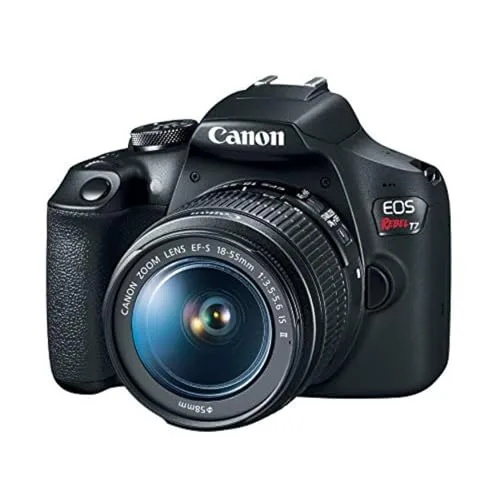
The Canon EOS Rebel T7 is designed to be the first step away from the smartphone. It is an entry-level DSLR (Digital Single-Lens Reflex) camera that strips away the digital trickery and gives you raw, optical performance. It is not the newest technology on the block—it lacks 4K video and touchscreens—but it remains the most cost-effective way to learn the actual craft of photography, understanding exposure, shutter speed, and aperture without breaking the bank.
2. Key Features Explained Simply
The Rebel T7 focuses on the fundamentals. Here is how the technical specs translate to your actual experience.
24.1 Megapixel APS-C Sensor
The Benefit: This is the engine of the camera. “APS-C” refers to the physical dimensions of the sensor. Because it is massive compared to a phone sensor, it gathers more light. This results in photos that have less “grain” (noise) in dim lighting and allows you to print photos as large as posters without them looking pixelated.
[Image of APS-C vs Smartphone Sensor Size comparison diagram]The EF/EF-S Lens Mount
The Benefit: The T7 uses Canon’s EF mount. This is arguably the most important feature. It gives you access to decades of affordable, high-quality lenses. You can buy a cheap “nifty fifty” (50mm f/1.8) lens for under $150 that will take portraits indistinguishable from professional work. You aren’t stuck with the lens in the box.
Optical Viewfinder
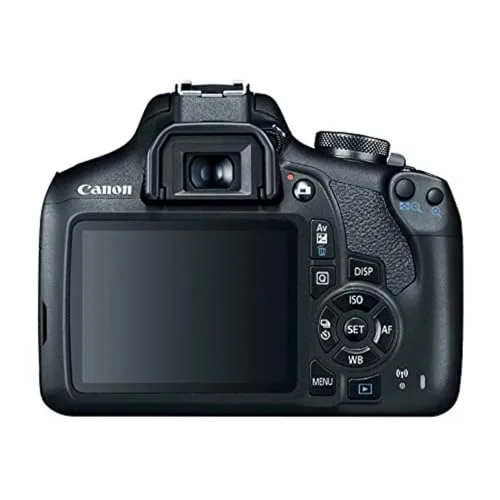
The Benefit: Unlike mirrorless cameras or phones where you look at a screen, the T7 uses mirrors to let you look directly through the lens. You see the world as it is, with zero lag. It also saves battery life because you aren’t powering a digital screen constantly.
Wi-Fi and NFC
The Benefit: While it is a traditional camera, it isn’t disconnected. You can transfer photos wirelessly to your phone via the Canon app. This allows you to take a high-quality DSLR photo and post it to Instagram minutes later.
3. Hands-On Use & Performance
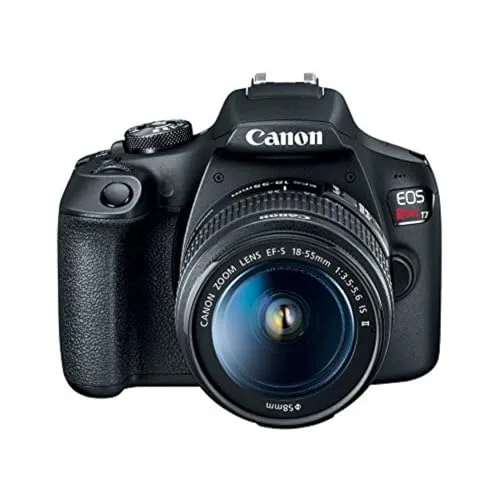
We evaluated the Rebel T7 from the perspective of a first-time user moving up from a mobile device.
Ergonomics and Build
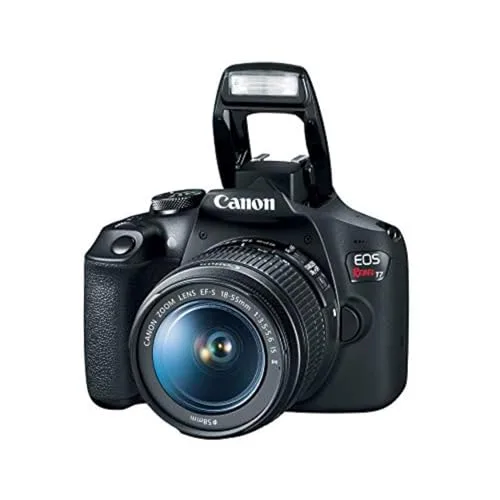
The camera body is made of polycarbonate resin (plastic) over a metal chassis. It doesn’t feel as “premium” as a $2,000 camera, but it is lightweight and durable. The grip is deep and rubberized, making it easy to hold securely with one hand—something impossible with a slim smartphone.
Autofocus Performance
The T7 uses a 9-point autofocus system. By modern standards, this is basic.
For Portraits/Landscapes: It is perfectly adequate. It locks on quickly and provides sharp results.
For Sports/Action: It struggles. With only 9 points clustered in the center, tracking a running dog or a soccer player is difficult compared to newer mirrorless systems. The burst rate is only 3 frames per second, so you have to time your shots carefully.
Video Quality
The T7 shoots 1080p Full HD video. The quality is decent for YouTube or family clips, offering that “cinematic” background blur. However, the autofocus during video is slow and tends to “hunt.” If you are looking primarily for a vlogging camera, this is not the best choice; it is a photography tool first, video tool second.
Battery Life
This is where the DSLR shines. Because you use the optical viewfinder, the battery lasts for approximately 500 shots. You can go on a weekend trip without needing to charge it, whereas mirrorless cameras often die after a few hours.
4. Pros and Cons Table
| ✅ The Pros | ❌ The Cons |
|---|---|
| Image Quality: 24MP APS-C sensor delivers professional-grade resolution. | Slow Burst: 3fps shooting speed is too slow for fast sports action. |
| Battery Life: Optical viewfinder allows for all-day shooting on one charge. | Fixed Screen: The rear LCD does not flip out or tilt, and is not a touchscreen. |
| Lens Ecosystem: Access to hundreds of affordable used and new EF lenses. | Video AF: Autofocus in video mode is slow and noisy compared to modern standards. |
| Price: One of the most affordable ways to get a large-sensor camera. | Dated Processor: The Digic 4+ chip shows its age in low-light processing speed. |
5. Comparison: Old School vs. New School
Should you buy this DSLR, or a newer Mirrorless camera?
| Main Product Canon EOS Rebel T7 |
The Mirrorless Rival Canon EOS R100 |
The Vlogger Option Sony ZV-1F |
|---|---|---|
| 🔧 Key Features Optical Viewfinder, DSLR Body |
🔧 Key Features Electronic Viewfinder, 4K Video |
🔧 Key Features Compact, Flip Screen |
| 👍 Pros Great battery, cheap lenses |
👍 Pros Faster autofocus, lighter |
👍 Pros Video-centric, fits in pocket |
| 👎 Cons Bulky, outdated AF points |
👎 Cons Worse battery life |
👎 Cons Fixed lens (can’t zoom much) |
| 📐 Type DSLR (Mirrors) |
📐 Type Mirrorless |
📐 Type Compact Point-and-Shoot |
| 🔋 Battery ~500 Shots |
🔋 Battery ~320 Shots |
🔋 Battery ~200 Shots |
| 🛡 Lens Mount EF / EF-S (Huge selection) |
🛡 Lens Mount RF / RF-S (Newer, pricey) |
🛡 Lens Mount Fixed (None) |
| 💲 Price Range $ (Entry Level) |
💲 Price Range $ (Entry Level) |
💲 Price Range $$ (Mid-Range) |
| 🎯 Best-Use Scenario Learning Photography |
🎯 Best-Use Scenario Travel & Hybrid Use |
🎯 Best-Use Scenario TikTok & Vlogging |
6. Who Should Buy This?
The Canon Rebel T7 is a specific tool for specific people:
- Photography Students: Many high school and college courses require a DSLR with full manual controls. This is the standard recommendation because it forces you to learn the exposure triangle without digital crutches.
- Parents on a Budget: If you want high-quality photos of birthdays, graduations, and holidays that look better than phone snaps, but don’t want to spend $1,000+.
- Tactile Learners: If you prefer holding a substantial camera with buttons and dials rather than tapping a small touchscreen, the ergonomics of the T7 are satisfying.
Who should skip it? If you want to shoot 4K video for a YouTube channel, this is not the camera for you. Look at the Canon R50 or Sony ZV-E10 instead. If you need to shoot fast-paced sports (like high school football), the slow burst rate will frustrate you.
7. Comparison Summary
The Canon EOS R100 is the modern mirrorless equivalent. It has better autofocus (Face/Eye detection), but the battery life is worse, and the native lenses are currently more expensive than the plentiful EF lenses available for the T7.
The Sony ZV-1F is better for video, but it has a smaller sensor and a fixed lens. You cannot change lenses to get a “zoomed in” look or a wide-angle look later on.
The Rebel T7 remains the king of value. It gives you the largest sensor and the biggest lens selection for the lowest price.
8. Final Verdict
The Canon EOS Rebel T7 is a camera that prioritizes the fundamentals of photography over modern bells and whistles. It lacks the advanced tracking and video features of 2025 mirrorless cameras, but it delivers where it counts: image quality.
By pairing a massive APS-C sensor with the versatile EF lens mount, it offers a creative ceiling that is miles higher than any smartphone. It is the perfect classroom camera—an affordable, reliable tool to master the art of photography.
Rating: 4.5/5 stars for Educational Value and Image Quality.
Read more articles on this topic: Cameras.