Odvex.Admin
Save time and money by checking the latest rankings and discounts on Odvex.
Canon RF 35mm F1.8 Macro IS STM Review: The Most Useful Lens in the Canon Lineup?
1. Introduction: Solving the “First Lens” Dilemma
When you buy a Canon EOS R camera, you are immediately faced with a problem. The “L-series” professional lenses are incredibly expensive and heavy, while the standard kit lenses often struggle in low light due to narrow apertures. You need something that bridges the gap—a lens that is affordable, compact, and capable of professional results.
The Canon RF 35mm F1.8 IS Macro STM is Canon’s answer to this problem. It is designed to be the “everyday carry” lens for the RF system. By combining a classic 35mm focal length with image stabilization and semi-macro capabilities, it attempts to do the job of three different lenses.
But at this price point, corners have to be cut. Is the autofocus fast enough for sports? Is the build quality durable enough for travel? In this review, we analyze whether this multi-purpose prime is a master of all trades or just a compromise.
2. Key Features Explained Simply
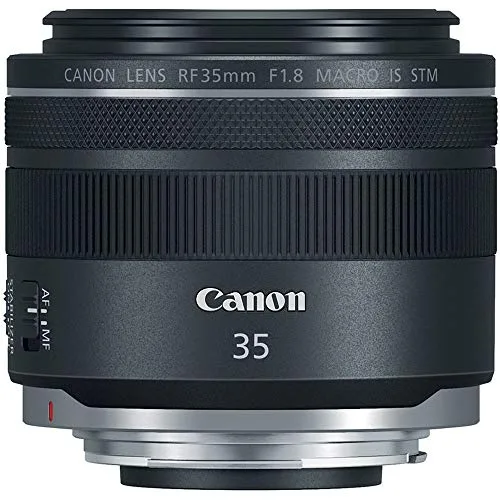
This lens packs a surprising amount of utility into a small plastic barrel. Here is what the specs actually mean for your photography.
0.5x Macro Capability (1:2 Magnification)
The Benefit: Most 35mm lenses can’t focus closer than a foot away. This lens can focus down to 6.7 inches (17cm). While it isn’t a “true” 1:1 macro (microscopic level), it provides 0.5x magnification. This is perfect for wedding ring shots, food photography textures, or detailed product shots. It eliminates the need to carry a separate macro lens for event work.
5-Stop Optical Image Stabilization (IS)
The Benefit: Stabilized prime lenses are rare. The 5-stop IS allows you to hand-hold the camera at shutter speeds as slow as 1/2 second (with good technique) and still get sharp static subjects. For video, it smooths out micro-jitters, making handheld walking shots usable without a gimbal.
Bright f/1.8 Aperture
The Benefit: This lens gathers 4x more light than a standard f/4 kit zoom. This means cleaner images indoors without using a flash. It also provides a shallow depth of field, blurring the background nicely to isolate your subject.
The “Control Ring”
The Benefit: Like all RF lenses, this features a customizable control ring at the front. You can map this to ISO, Aperture, or Exposure Compensation. It adds a tactile, mechanical feel to the shooting experience, allowing you to adjust settings without taking your eye off the viewfinder.
3. Hands-On Use & Performance
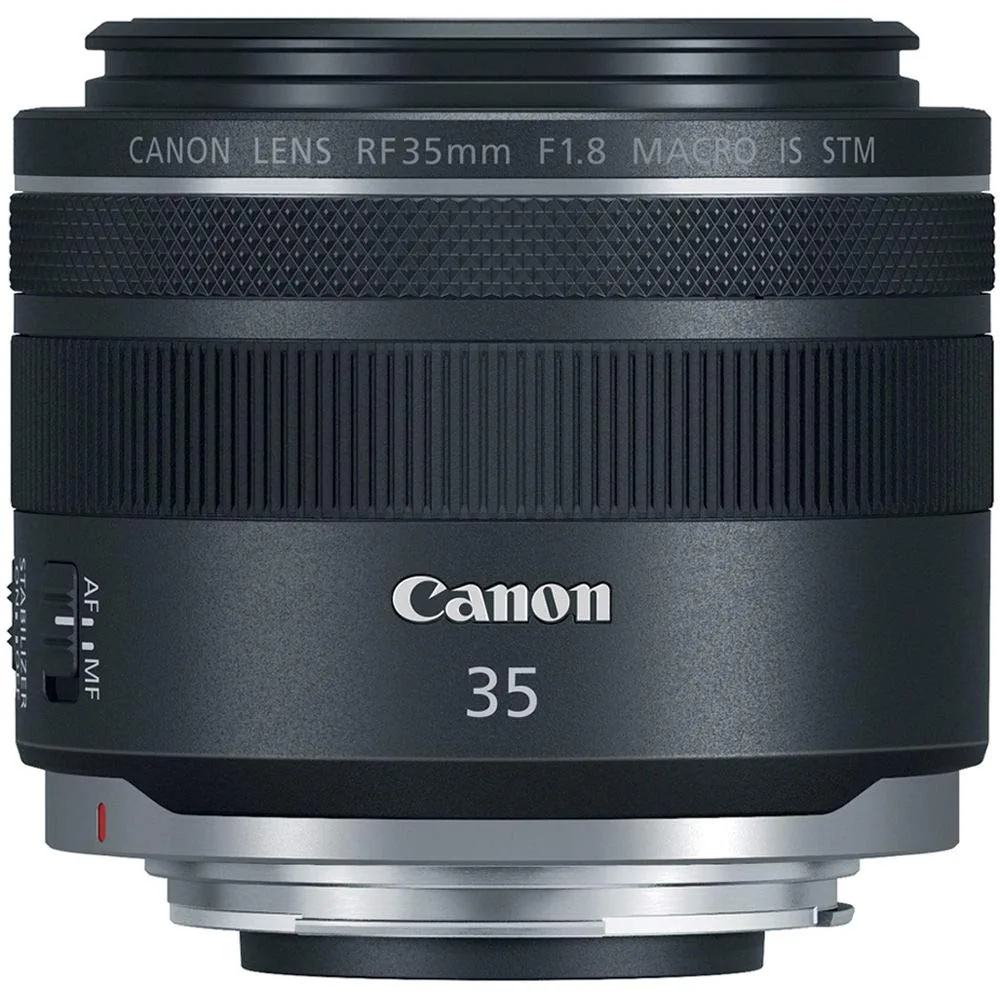
We tested the RF 35mm f/1.8 on a Canon EOS R6 and R8 across street photography, video vlogging, and product shots.
Sharpness and Optical Quality
In the center of the frame, this lens is razor-sharp, even wide open at f/1.8. It rivals lenses that cost twice as much. However, the corners are softer wide open, and there is noticeable vignetting (dark corners) at f/1.8. Stopping down to f/2.8 cures most of these issues. For portraits and street photography, the center sharpness is what matters most, and this lens delivers.
Autofocus Performance (STM Motor)
The STM (Stepping Motor) is smooth and accurate, but it is not instant. It is slower than the “Nano USM” motors found in L-series lenses.
For Video: The focus transitions are cinematic and smooth. However, the motor makes a slight buzzing/whirring noise. If you are using the on-camera microphone in a quiet room, you might pick up this sound.
Focus Breathing: This lens exhibits noticeable focus breathing. As you change focus from near to far, the image zooms in and out slightly. This is a distraction for professional videography but negligible for photography.
Build Quality
The lens is made of high-quality polycarbonate (plastic) with a metal mount. It feels solid but lacks the weather sealing of the L-series. The lens barrel physically extends when focusing on close subjects, which is a point of vulnerability for dust or impact.
4. Pros and Cons Table
| ✅ The Pros | ❌ The Cons |
|---|---|
| Versatility: It acts as a wide-angle, a low-light prime, and a macro lens all in one. | Focus Breathing: Significant field-of-view shift when focusing (distracting for video). |
| Stabilization: The 5-stop IS is a lifesaver for handheld video and night photography. | Motor Noise: The STM motor is audible in quiet video environments. |
| Sharpness: Excellent center sharpness that rivals professional glass. | No Weather Sealing: Not built for heavy rain or dusty environments. |
| Compact: Small and light enough to leave on your camera permanently. | Barrel Extension: The front element moves in and out, which feels less robust. |
5. Comparison: Finding the Right RF Prime
How does the humble 35mm f/1.8 stack up against the budget king and the professional master?
| Main Product Canon RF 35mm f/1.8 IS |
The Budget Option Canon RF 50mm f/1.8 STM |
The Pro Upgrade Canon RF 35mm f/1.4 L VCM |
|---|---|---|
| 🔧 Key Features Macro (0.5x), Stabilization |
🔧 Key Features Compact “Nifty Fifty” |
🔧 Key Features VCM Motor, Iris Ring |
| 👍 Pros Best versatility & value |
👍 Pros Extremely cheap & tiny |
👍 Pros Perfect optics, Silent AF |
| 👎 Cons Noisy AF, Focus breathing |
👎 Cons No Stabilization (IS) |
👎 Cons Very Expensive ($1499+) |
| 📐 Focal Length 35mm (Wide-Standard) |
📐 Focal Length 50mm (Standard) |
📐 Focal Length 35mm (Wide-Standard) |
| 🔋 Stabilization ✅ Yes (5 Stops) |
🔋 Stabilization ❌ No (Body Only) |
🔋 Stabilization ❌ No (Body Only) |
| 🛡 Durability Consumer Grade |
🛡 Durability Consumer Grade |
🛡 Durability Pro Weather Sealed |
| 💲 Price Range $$ (Mid-Range) |
💲 Price Range $ (Budget) |
💲 Price Range $$$$ (Premium) |
| 🎯 Best-Use Scenario Vlogging, Travel, Macro |
🎯 Best-Use Scenario Portraits on a budget |
🎯 Best-Use Scenario Pro Video & Weddings |
6. Who Should Buy This?
The Canon RF 35mm F1.8 fits specific creative profiles perfectly:
- The Vlogger / YouTuber: The 35mm focal length is wide enough to film yourself at arm’s length, and the Image Stabilization keeps the footage usable while walking.
- The Wedding Photographer: It is an affordable lens for detail shots (rings, flowers) thanks to the macro mode, and works as a great backup dance-floor lens.
- The Street Photographer: It is small, unobtrusive, and fast enough for night street photography without drawing attention.
Who should skip it? Professional filmmakers who require zero focus breathing and silent autofocus should look at the RF 35mm f/1.4 L VCM. Landscape photographers who need corner-to-corner sharpness at all apertures might prefer the RF 15-35mm f/2.8 L.
7. Comparison Summary
The RF 50mm f/1.8 is cheaper, but 50mm is often too “tight” for indoors and vlogging, and it lacks stabilization. It’s a great second lens, but not a great only lens.
The RF 35mm f/1.4 L VCM is technically superior in every way (optics, speed, build), but it costs nearly three times as much. Unless you are paid to shoot, the f/1.8 version offers 90% of the performance for a fraction of the price.
The RF 35mm f/1.8 IS Macro remains the sweet spot. It does things even the expensive L-series can’t do (like 0.5x macro and optical stabilization).
8. Final Verdict
The Canon RF 35mm F1.8 IS Macro STM is arguably the best value-for-money lens in the entire Canon RF ecosystem. It is a rare “Swiss Army Knife” that actually performs well in all its functions.
While it feels a bit plasticky and the focus motor isn’t silent, the ability to shoot macro, handheld video, and low-light portraits with a single $500 lens is unmatched. It should be the first prime lens every EOS R owner buys.
Rating: 5/5 stars for Value and Versatility.
Read more articles on this topic: Lens.